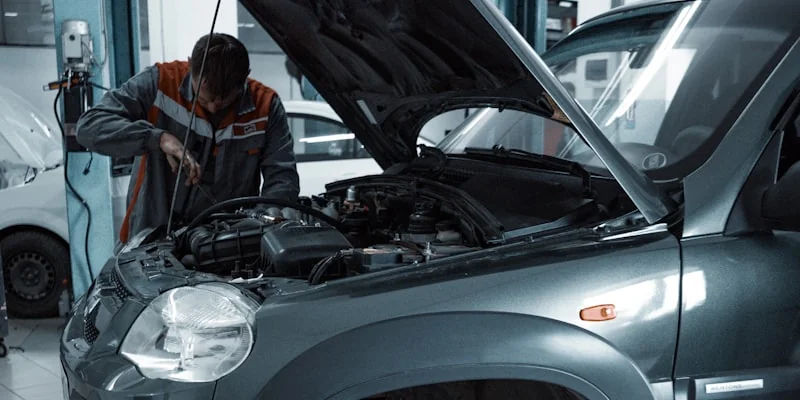
Dubai drivers delay car repairs more than almost any other market I work in. The reasons are understandable — busy schedules, the car still moves, the warning light has been on for weeks with no obvious consequence. But in UAE summer heat, a car that is sending warning signals has a dramatically shorter window before a minor problem becomes an expensive failure. Here are the ten warning signs I see ignored most often, and what each one actually means.
1. Temperature Warning Light (Red Thermometer)
🚨 STOP DRIVING — this is an immediate action warning
The red temperature warning light means coolant temperature has exceeded the safe operating threshold. In August, at 46°C ambient, this can escalate from warning to a destroyed engine within minutes. Turn off the AC, switch the heater to maximum heat and fan speed, and pull over safely as soon as possible. Do not continue driving. The difference between stopping at the first warning and continuing: AED 500 repair versus AED 15,000+ engine damage.
2. Oil Pressure Warning Light (Red Oil Can)
🚨 STOP THE ENGINE — running on low oil pressure destroys bearings in seconds
A red oil pressure light is not the same as low oil level — it means the oil circulation system is not building pressure. This could be a failed oil pump, severely low oil level, a blocked oil pickup, or a blocked oil gallery. Running even 30 seconds at low oil pressure at UAE operating temperatures can score main bearings and camshaft journals irreparably. Turn off the engine immediately, check the oil level on the dipstick, and call for assistance.
3. Battery / Charging System Warning (Red Battery)
⚠️ Act today — your car will strand you without warning when the battery dies
A battery warning light does not always mean the battery is dead — it usually means the alternator is not charging the battery correctly. A failing alternator will eventually drain the battery completely, typically leaving you stranded at a traffic light or in a car park. In Dubai's heat, a battery at less than 60% charge capacity can fail to start the engine on the next attempt. Have the charging system tested immediately — alternator replacement costs AED 800–1,800 and prevents a far more inconvenient roadside breakdown.
4. Check Engine Light (Amber Engine Outline)
⚠️ Steady: investigate within a week. Flashing: pull over now — active misfires are damaging your catalytic converter
A steady amber check engine light means a fault has been stored — investigate soon but not immediately. A flashing check engine light means active engine misfires are happening right now, sending raw fuel into the catalytic converter and raising it to damaging temperatures. In UAE heat, a catalytic converter under misfire conditions can crack within minutes. Flashing check engine = stop driving. Have an OBD scan run — it takes 10 minutes and tells you exactly which system is at fault.
5. Brake Warning Light (Amber or Red Exclamation in Circle)
🚨 Red brake light = immediate inspection. Do not drive if brake pedal feels soft or spongy
A red brake warning light while moving (not the handbrake) means critically low brake fluid — which almost always indicates a brake fluid leak. In Dubai's summer heat, brake fade from overheated fluid is already a risk; a system that is also low on fluid is a serious safety hazard. A soft or spongy brake pedal means air has entered the system — brakes can fail with no warning. This is not a "book in next week" situation. If the pedal feels normal but the light is on, inspect the fluid level immediately and trace the source of the loss.
6. Power Steering Warning Light
⚠️ Investigate today — sudden steering failure at highway speed is catastrophic
Modern vehicles with electric power steering (EPS) use a steering warning light to flag motor or sensor faults. The danger is that EPS failures can be intermittent — the steering feels normal, then suddenly requires full arm strength to turn. At Dubai highway speeds (120 km/h), sudden loss of power steering assistance makes lane changes and emergency avoidance extremely difficult. Have the fault code read before your next highway drive.
7. Tyre Pressure Warning (TPMS — Yellow Horseshoe with Exclamation)
⚠️ Check all four tyres before driving — blowout risk increases dramatically at low pressure in UAE heat
The TPMS light illuminates when a tyre is more than 25% below the recommended pressure. On UAE summer roads, where tarmac surface temperatures reach 70°C, a significantly under-inflated tyre generates extreme internal heat — the leading cause of tyre blowout. A blowout on Sheikh Zayed Road or the E11 at speed is a life-threatening event. Check all four tyres with a gauge (TPMS sensors can sometimes fail and not trigger for every tyre) and inflate to the door-jamb specification. Do not drive at speed with the TPMS light on.
8. Engine Temperature Gauge Creeping High (Not Yet at Red)
⚠️ If the gauge is sitting noticeably higher than its usual midpoint — investigate before the next drive
Most drivers do not know where their temperature gauge usually sits. In normal operation, it should stabilise at or slightly below the midpoint within a few minutes of driving and stay there in traffic. If you notice it sitting higher than its usual position, even if not yet in the red zone, this is an early warning of a cooling system issue — low coolant, a thermostat beginning to fail, or a cooling fan not operating at full capacity. Catching these issues in the early stage costs AED 150–500. Ignoring them until the red light appears can cost ten times that.
9. Vibration Through the Steering Wheel or Brake Pedal
⚠️ Investigate within the week — this indicates structural wear that worsens quickly in UAE summer driving
Steering wheel vibration at highway speed typically indicates wheel balancing issues or worn suspension components. Brake pedal pulsation when stopping — a rhythmic judder felt through the pedal — indicates warped brake rotors. In Dubai's summer, heavily loaded brake rotors (from repeated hard braking in traffic) warp faster than in cooler climates. Warped rotors compromise braking consistency. Neither problem resolves itself — both get worse with continued driving, and the repair cost escalates as secondary components wear.
10. Unusual Noises — Grinding, Squealing, Knocking
⚠️ Have it diagnosed within a week — noise means something is making contact or operating beyond its design limits
A grinding noise when braking means the brake pads have worn through to the metal backing plate, which is now grinding against the rotor. Every kilometre driven in this condition scores the rotor surface, adding AED 300–600 in rotor replacement cost to what would have been an AED 200 pad-only job. A knocking from the engine at idle — particularly a rhythmic, oil-related knock — can indicate big-end or main bearing wear. In UAE summer heat, worn bearings fail faster because oil viscosity is at its lower limit at operating temperature. A metallic rattle from the front suspension means worn ball joints or control arm bushings — components that, when they fail completely, cause loss of wheel alignment and potentially loss of directional control.
The Common Thread
Every warning sign in this list has the same pattern: caught early, it is a relatively inexpensive repair. Ignored in Dubai's summer heat, the problem accelerates — the heat, the sand, the stop-start traffic, and the long highway distances all act as multipliers on mechanical wear. The cost of a diagnostic scan at FixHive is AED 100–150. The cost of the repairs it prevents runs into thousands.
📲 Book a Diagnostic Check