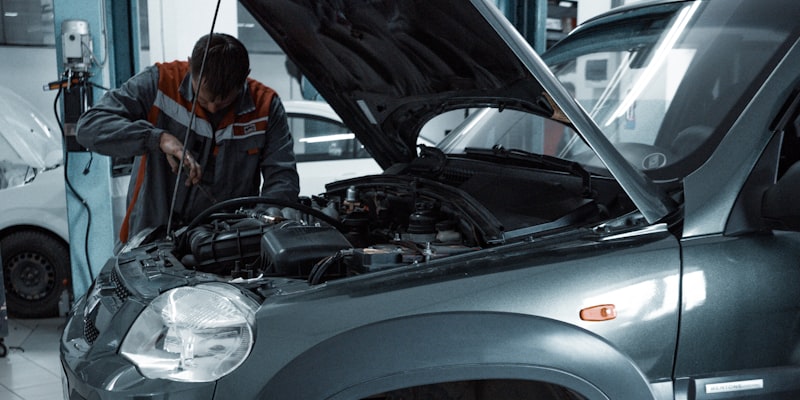
The decisions you make in the first 60 seconds of an overheating event determine whether you walk away with a repair bill or a write-off. Here is the correct emergency response, the most common UAE summer causes, and what the damage costs if you ignore the warning.
Act Immediately When the Temperature Warning Appears
Turn off AC, switch the heater to maximum heat and fan speed (it acts as a secondary radiator), try to get onto a flowing road for airflow. If the gauge continues rising, pull over safely and switch off. Never open the radiator cap when hot — pressurised coolant causes severe burns. Do not restart and drive. The difference between stopping at the first warning and continuing: AED 300 versus AED 8,000–25,000.
The Most Common Causes in UAE August
Coolant leaks (hose, water pump seal or radiator) that were manageable in cooler months drain fast in August heat. Degraded coolant with exhausted inhibitors has a lower effective boiling point. A thermostat stuck closed prevents coolant reaching the radiator. A failed water pump circulates nothing. A head gasket leak pressurises the cooling system and prevents effective cooling.
What the Damage Costs
Stopped at first warning light: root cause repair only — AED 300–1,800. Ran 5–10 minutes in the red: possible head gasket damage — AED 3,000–8,000. Continued driving until the car stopped: warped head, blown gasket or cracked block — AED 8,000–25,000+. The engineering is unforgiving — act early.
A solid check engine light means investigate soon. A flashing light means pull over now — active misfires are damaging your catalytic converter. Here are the most common codes in UAE summer, what each actually means, and the ones that require immediate action.
Solid vs Flashing — The Critical Difference
A steady check engine light means a stored fault — investigate within a week. A flashing light means active misfires severe enough to damage the catalytic converter — pull over as soon as safely possible. In UAE heat, misfires cause abnormal catalytic converter temperatures that crack an already expensive component (AED 1,200–4,500 replacement).
Common UAE Summer Codes
P0128 (thermostat stuck open — engine running cold), P0171/P0174 (running lean — cracked rubber intake hoses common in UAE heat), P0300–P0308 (misfires — worn plugs or failed ignition coils in hot engine bay), P0420 (catalytic efficiency below threshold — may be failed cat or oxygen sensor), P0455 (EVAP leak — often a loose fuel cap first).
Stop Driving Immediately If
The check engine light is flashing, the check engine light appears together with the temperature warning, or with oil pressure warning. Any combination of two warning lights simultaneously in August heat is a "stop the engine now" situation.
In Dubai's August heat, a dead AC is not a comfort issue — it is a safety situation. Cabin temperatures hit 80°C. Here is how to diagnose what failed — compressor clutch, zero refrigerant, condenser, blower motor — before the mechanic starts quoting parts.
Diagnose the Failure Type First
Fan blows warm air: the blower and electrics are fine — the refrigeration circuit has failed. No air movement at all: check the cabin blower fuse first (AED 5–15 fix), then blower motor resistor (AED 120–280), then blower motor. Fan works on some speeds only: blower resistor failure — common and inexpensive.
The Compressor — Most Common Complete Failure
A failed compressor clutch (visible — the pulley spins but the centre hub does not) is separate from compressor seizure. Clutch replacement: AED 450–900. Full compressor replacement including system flush, new drier, expansion valve and recharge: AED 1,800–4,500. Never replace only the compressor without flushing — metal particles will destroy the new unit.
Why August Is the Hardest Month
By August, the AC has run continuously at full capacity since May. The condenser rejects heat into 46°C ambient air instead of 20°C. Engine bay temperatures exceed 70°C for months. Every marginal component — compressor seals, hose O-rings, receiver-drier desiccant — is at or past end of service life in August.
A sweet smell from the engine bay, a coloured puddle under the car, a dropping coolant level — all signs of a leak. In August, a slow drip becomes a fast drain at operating temperature and pressure. Here is how to find the source and what each repair costs in Dubai.
Recognise the Signs Before They Escalate
Coolant level dropping between checks, sweet smell from engine or cabin, coloured puddle under the front of the car, white smoke from exhaust, or white crusty deposits around hose fittings — any of these in August heat requires same-day attention, not a next-week appointment.
Common Leak Sources in UAE Conditions
Radiator hoses hardened and cracked by UV and heat cycles: AED 80–200 per hose. Hose clamps losing tension on compressed rubber: AED 30–80. Radiator plastic-to-aluminium joint failure: AED 500–1,200. Water pump seal weeping through the pump's weep hole: AED 600–1,800. Thermostat housing cracked from heat cycling: AED 200–500. Heater core leak (coolant in footwell): AED 900–3,000. Head gasket (internal leak — no external puddle): AED 3,000–8,000.
The Pressure Test — 20 Minutes to Find Any Leak
A cooling system pressure test pressurises the system to the radiator cap's rated pressure and holds it. Pressure drop identifies an external leak; a block test dye then identifies internal combustion ingress through the head gasket. This is the definitive diagnostic and takes 20–30 minutes — ask for it before any leak-related work begins.
Every warning sign has the same pattern in Dubai's heat: caught early, it is an inexpensive repair. Ignored through August, the problem accelerates — heat, sand, and stop-start traffic act as multipliers on mechanical wear. Here are the 10 signs I see ignored most often, and what each one actually means.
Immediate Action Warnings
Red temperature light — stop the engine, do not continue. Red oil pressure light — stop the engine in seconds, running on low oil pressure destroys bearings. Red brake warning light while moving — critically low brake fluid, possible brake system leak. Flashing check engine light — active misfires are damaging the catalytic converter right now.
Investigate Today
Battery / charging warning — your alternator is failing; the car will strand you without notice. Amber check engine (steady) — store fault code, investigate within a week. TPMS warning — check all four tyres before driving at speed; blowout risk increases dramatically on 70°C UAE road surfaces. Power steering warning — intermittent EPS failure at speed is dangerous.
The Pattern
The cost of a diagnostic scan at FixHive is AED 100–150. The cost of the repairs it prevents — bearing damage, catalytic converter failure, engine overheating — runs into thousands. In August, a marginal component that might have held on for another month will not.
Dubai's summer is mechanically destructive. Ambient temperatures above 46°C, surface temperatures on parked components exceeding 80°C, and humidity cycles that corrode electrical connections create a failure environment that compresses years of wear into a single season. Here is what heat is doing to every system in your car.
Battery — Dubai's Most Predictable Casualty
A battery that lasts 5 years in a temperate climate lasts 2.5–3 years in Dubai. Heat accelerates electrolyte evaporation and plate corrosion. A battery at 60% capacity reads 12.5V at rest and still fails under starting load in August afternoon heat. Load-test any battery over 2 years old — voltage testing alone misses heat-degraded capacity.
Tyres and Engine Oil
UAE road surfaces reach 70°C. An under-inflated tyre on this surface generates internal heat that degrades the rubber-to-cord bond — the mechanism behind blowouts. Sidewalls older than 5 years have invisible microcracking regardless of tread depth. Engine oil viscosity at UAE operating temperatures sits at the upper limit of its specification — degraded oil with depleted antioxidants thins beyond design limits, causing metal-on-metal contact at bearings.
The Cost Comparison
Battery failure: AED 350–900 reactive, AED 50 preventive load test. Tyre blowout: AED 400–900 per tyre plus possible bodywork, versus AED 20 pressure check. AC compressor failure: AED 2,500–6,000 versus AED 300–500 gas recharge. A summer inspection is the most cost-effective automotive purchase of the UAE year.
Your cooling system works harder in July than any other month. Old coolant becomes acidic, scale reduces heat transfer, and a marginal thermostat fails in traffic. Here is what a proper flush involves and when you need one.
What Is a Radiator Flush?
A radiator flush drains the entire cooling system, flushes with a cleaning solution to remove scale and old additive residue, then refills with fresh manufacturer-specified coolant at the correct concentration. It is not the same as a coolant top-up, which adds fluid to an already-degraded mixture.
Why Old Coolant Fails in UAE Conditions
Coolant contains corrosion inhibitors that deplete faster in UAE heat cycles. Once exhausted, the coolant becomes acidic and attacks aluminium components — radiator core, water pump housing, thermostat housing and cylinder head passages. In Dubai's extreme heat, this process accelerates significantly compared to temperate climates.
Signs Your Cooling System Needs Attention
Coolant that has turned brown or cloudy, a temperature gauge sitting slightly higher than usual in traffic, a sweet smell from the engine bay, white residue around hose clamps, or coolant level dropping between services are all warning signs that need immediate attention in July.
How Often Should You Flush in the UAE?
While manufacturers specify every 2 years or 60,000 km, we recommend every 2 years or 40,000 km in the UAE due to accelerated inhibitor depletion from extreme heat cycling. If your coolant is more than 2 years old and you have not flushed it, July is the worst month to delay.
Interior cabin temperatures hit 80°C in July. Tyre blowouts cluster in peak summer. Batteries fail under sustained AC load. Here is what to check, how to protect your car when parked, and exactly what to do if your temperature gauge rises in traffic.
The Three Systems Most Likely to Fail in July
Car failures in the UAE cluster in June, July and August. Cooling system leaks that were manageable in May cause overheating in July traffic. Batteries aged over two years struggle under continuous AC load. Underinflated tyres on 70°C tarmac at highway speeds are a blowout risk.
What to Check Every Few Days in July
Check coolant level when the engine is cold — any drop indicates a leak, not just a top-up situation. Check tyre pressure in the morning before driving. Pull the dipstick before a cold start to confirm oil is between MIN and MAX.
What to Do If Your Temperature Gauge Rises
Turn the AC off immediately and switch the heater to maximum heat and fan — the heater core acts as a secondary radiator. If the gauge continues rising, pull over safely and switch off. Never open the radiator cap on a hot engine. Driving an overheating engine risks AED 3,000–18,000 in damage.
Protecting Your Car When Parked
Use a windscreen sunshade — it reduces interior temperature by 15–20°C. Park in shade when possible. Run the AC on recirculation for the first 2–3 minutes to cool faster. Leave windows cracked 10–15 mm in secure locations to allow convection cooling.
Most drivers associate battery failures with cold winters. In Dubai it is the opposite — July heat is the primary battery killer. Here is why, the warning signs to watch for, and how to avoid being stranded in 46°C heat.
Why Heat Kills Batteries Faster Than Cold
High temperatures accelerate the internal chemical reaction in lead-acid batteries — causing plate corrosion, electrolyte water loss and faster self-discharge. Every 10°C above 25°C roughly halves battery life. In Dubai's July heat, a battery that might last 5 years in a temperate climate may only survive 2–3 years.
The Air Conditioning Effect
In July, your AC compressor runs continuously, placing sustained electrical demand on the battery at every traffic stop. An older battery that handles normal loads may fail under continuous maximum AC output — and the battery warning light often does not illuminate until after the failure occurs.
Warning Signs to Act On Now
Slow cranking on cold start, dimming headlights at idle, a clicking sound instead of engine cranking, a battery over 3 years old, or a visibly swollen battery case. Any of these in July means book a battery load test — not next week.
AGM vs Standard Batteries for UAE
AGM (Absorbent Glass Mat) batteries handle heat and deep discharge significantly better than conventional flooded batteries — worth the premium for UAE conditions, especially vehicles with start-stop systems. Standard replacement: AED 250–450; AGM: AED 550–950 fitted.
UAE road surfaces hit 70°C in July. Underinflated tyres, worn tread and aged rubber are the three causes of summer blowouts — and most are preventable. Here is what to check and the correct response if a blowout happens at highway speed.
Why Dubai's Roads Are Uniquely Hard on Tyres
Tarmac surface temperatures reach 65–75°C in July. A tyre rolling across this absorbs road heat on top of its own flex heat — creating conditions far outside what tyres experience in temperate climates. Underinflation, worn tread and rubber aged beyond 5 years are the three leading causes of blowouts in UAE summer.
Check Pressure Every 3–4 Days in July
Always check when the car has been parked for at least 3 hours — hot tyres read 4–8 PSI higher than cold. The correct pressure is on the driver's door jamb placard, not the tyre sidewall. Never deflate a hot tyre to compensate for thermal expansion.
The Correct Blowout Response
Do not brake and do not steer sharply. Grip the wheel firmly, ease off the accelerator, let the car decelerate naturally, then steer gradually to the hard shoulder only once below 60 km/h. Panicking and braking hard causes accidents — controlled deceleration does not.
Tyre Age Matters as Much as Tread
Check the 4-digit date code on the sidewall (week + year). Replace any tyre over 5 years old in UAE conditions regardless of tread depth — UV radiation and heat degrade internal structure that looks fine visually.
A closed AC system should not lose refrigerant. If yours is low, there is a leak — and topping up gas without finding it is a temporary fix. Here is what a proper recharge involves, the R134a vs R1234yf difference, and the costs at an independent garage versus the dealer.
Low Refrigerant Always Means a Leak
Car AC systems are closed loops — refrigerant does not deplete normally. If the system is low, gas is escaping somewhere. Adding refrigerant without finding and fixing the leak results in the same problem within weeks. A proper service uses leak detection (electronic or UV dye) before touching the gas charge.
The Correct Recharge Procedure
Pressure test on both service ports, leak detection, full vacuum to remove moisture and air contamination, then recharge by weight to the manufacturer-specified quantity in grams. Verify with vent temperature measurement — a correctly charged system should achieve 4–8°C at the centre vent in UAE summer conditions.
R134a vs R1234yf — Know Which Your Car Uses
These refrigerants are not interchangeable. R1234yf (vehicles from approximately 2018 onward) costs significantly more — AED 80–120 per 100g versus AED 20–35 for R134a. If a garage quotes the same price regardless of which gas your car uses, ask specifically what they are charging.
When a Recharge Won't Fix the Problem
A recharge doesn't address a blocked cabin filter, failed compressor, blocked condenser, faulty expansion valve or leaking evaporator — all of which cause inadequate cooling regardless of refrigerant charge. Diagnosis first, recharge second.
Brake fluid boils at lower temperatures when moisture-contaminated. Pads glaze under sustained summer heat. Rotors warp from rapid thermal cycling between hot highways and cold car parks. Here is what changes in UAE summer and the warning signs that need immediate attention.
Brake Fluid — The Hidden Risk
Brake fluid absorbs moisture over time, which drops its boiling point. When degraded fluid boils under heavy braking, vapour bubbles cause a spongy or unresponsive pedal — brake fade. In UAE summer conditions this is a genuine safety risk. Replace brake fluid every 2 years regardless of mileage.
Pad Glazing and Reduced Stopping Power
Sustained operation at the upper end of pad compound temperature ranges causes the surface to harden and glaze — reducing friction effectiveness. Symptoms: reduced stopping power and high-pitched squeal under braking, even with adequate pad thickness remaining.
Rotor Warping in UAE Conditions
Rapid heating on the highway followed by thermal shock entering an air-conditioned car park stresses rotors. A warped rotor produces a pulsing sensation through the brake pedal and steering wheel. More common in UAE than temperate climates due to daily heat cycling.
Warning Signs That Need Immediate Action
Grinding noise when braking (metal on metal — stop driving), soft or spongy pedal (degraded fluid or air in system), car pulling to one side, or burning smell after normal city driving (seized caliper — fire risk in severe cases). Any of these: book immediately.
The Audi Q7 is everywhere in Dubai — but its timing chain, air suspension and DSG can be expensive surprises. Here is the honest rundown of every known Q7 weak point and what proactive maintenance costs in the UAE.
Timing Chain Stretch — The Most Serious Issue
The 3.0 TFSI V6 in the Q7 uses a timing chain rather than a belt — but the chain system has well-documented stretch issues, particularly when oil change intervals are extended. In Dubai's heat, engine oil degrades faster than in cooler climates, accelerating chain and tensioner wear. Symptoms: cold-start rattle that disappears once oil pressure builds, check engine lights with P0011/P0014/P0341 camshaft timing codes. A timing chain service is 3,000–6,000 AED at a specialist. Left unaddressed, a jumped chain causes catastrophic engine damage.
Air Suspension Failures
Air bag bladder cracking, compressor wear and height sensor failure are the most common Q7 repairs we see in Dubai. The first sign is usually one corner sitting lower overnight. Air strut replacement is 1,500–3,500 AED per corner. Replacing struts in pairs is strongly recommended — when one side fails, the other typically follows within months.
DSG/S Tronic Gearbox Service
Audi recommends DSG fluid every 40,000 km — we recommend the same in UAE conditions regardless of time elapsed. Neglected DSG fluid leads to jerky low-speed engagement, harsh upshifts and eventual dual-clutch pack failure (6,000–12,000 AED).
Oil Consumption on the 3.0 TFSI
Consumption of 0.5–1 litre per 1,000 km is within Audi's specification. In Dubai's heat, expect the higher end. Check your oil every 2,000–3,000 km — do not wait for the dashboard warning.
The Range Rover Sport L494 is prestige and capability in one package — and its repair bills are equally well-known. Here is the complete guide to its failure patterns, what maintenance costs in Dubai, and what to watch for before problems become expensive.
Air Suspension — The Most Common Failure
Air bag bladder cracking, compressor wear and height sensor failure are the most frequent Range Rover Sport repairs in Dubai. The first sign is a corner sitting lower than the others after parking. Air strut replacement is 2,000–4,000 AED per corner; the overworked compressor often needs replacement at the same time (800–1,800 AED). Replace in axle pairs — when one side fails, the other typically follows within months.
Timing Chain — 3.0 Si6 Supercharged V6 Weakness
The Si6 supercharged V6 (2013–2018 Sport) has documented timing chain stretch at higher mileage. Cold-start metallic rattle is the early warning sign. Left unaddressed, timing chain stretch leads to VVT faults, reduced power and eventually catastrophic failure. A timing chain service is 5,000–9,000 AED at a specialist.
Transfer Case and Driveline Fluid Service
Land Rover's "sealed for life" designations do not apply in UAE conditions. We recommend transfer case, rear differential and ZF 8HP gearbox fluid changes every 60,000 km. A complete driveline fluid service costs 1,200–2,500 AED — a failed rear differential or transfer case costs 8,000–20,000 AED.
Cooling System — Critical in Dubai Summer
Coolant hose connections and the oil-to-water heat exchanger are known failure points. Signs: coolant level dropping without visible leaks, or a mayonnaise residue in the oil (indicating head gasket or heat exchanger failure). Do not delay — overheating a Range Rover Sport engine is among the most expensive repair scenarios we see.
Dubai's streets are full of Ferraris. What is less discussed is what they cost to maintain properly. Annual service, major service, belt service — here is the honest breakdown of what you pay at the dealer and what a qualified independent specialist charges for the same work.
Annual Service
Ferrari's annual service covers engine oil and filter (Shell Helix Ultra or equivalent full synthetic), annual brake fluid replacement (critical — high-performance brakes generate heat that degrades fluid faster than standard vehicles), battery maintenance, coolant check and electronic health scan. Cost at the official dealer: 4,500–8,000 AED. At a qualified independent specialist: 2,500–4,500 AED.
Major Service
Every 3–4 years the major service adds spark plug replacement (iridium plugs at premium prices — 8 on a V8, 12 on a V12), gearbox fluid, air filter and a full chassis check. Dealer cost: 8,000–18,000 AED. Specialist cost: 5,000–12,000 AED.
The Belt Service — The Biggest Scheduled Cost
Belt-driven Ferraris (California T, older 458, F430) require belt replacement at the 7-year/30,000 km interval. The engine must be substantially disassembled for access. Dealer cost: 25,000–45,000 AED. Independent specialist: 15,000–28,000 AED. Chain-driven engines (488, F8, Roma, SF90) have lower scheduled costs but still require chain tensioner inspection at specific intervals.
Dubai-Specific Considerations
Battery maintenance is critical — Ferraris parked infrequently (common in the UAE where many owners have multiple vehicles) drain from always-on electronics. A battery tender when parked prevents cell damage. Brake fluid must be replaced annually — not optional in Dubai's heat. Rear tyres on V8 models should be expected every 15,000–20,000 km with enthusiastic driving.
The Audi A6 is one of Dubai's most popular executive saloons. Here is a complete maintenance guide covering correct oil specifications, known issues across both generations, and what servicing should realistically cost.
Oil Specification and Change Intervals
Audi specifies VW 502.00 or 504.00 oil for petrol A6 engines and VW 507.00 for diesel variants. Using off-spec oil is a common cause of timing chain stretch and oil sludge on the 2.0 TFSI and 3.0 TFSI engines. In UAE conditions, change oil every 7,500–10,000 km — not the 15,000–20,000 km Longlife service that the onboard computer may suggest.
C7 (2011–2018) Known Issues
Timing chain tensioner wear (2.0 TFSI): Rattle on cold start is the warning — address immediately to avoid chain jump
MMI infotainment failure: Screen freezing and navigation errors are common on high-mileage C7 — often a hard drive failure
DSG/S tronic hesitation: Mechatronic unit faults and clutch pack wear cause jerky low-speed behaviour
Air suspension (3.0 models): Compressor failure and air bag leaks — same as Audi Group siblings
C8 (2018–Present): More Complex Electronics
The C8 A6 brought the Virtual Cockpit and MIB3 infotainment — significantly more reliable than C7 electronics. However, the mild hybrid system (MHEV) on 3.0 TFSI and 55 TFSI variants has produced some belt-starter-generator noise complaints. The 48V mild hybrid battery should be checked if the start-stop system becomes erratic.
Quattro Differential Service
Quattro AWD models require rear differential fluid changes every 60,000 km. This is frequently skipped at generic workshops — verify it has been done. Contaminated diff fluid causes whining under load and eventual bearing failure.
Does your car have a timing belt or chain? The answer determines one of the most expensive maintenance items on your schedule — and the consequences of getting it wrong are catastrophic.
The Fundamental Difference
Both timing belts and chains synchronise the crankshaft and camshaft(s) to ensure valves open and close at precisely the right moment. A timing belt is a rubber-and-fibre toothed belt — it is quiet but has a finite service life. A timing chain is metal — it lasts longer but can stretch and rattle if oil maintenance is neglected.
Which Cars Use Belts?
Common UAE cars with timing belts include: Toyota Corolla (older 1ZZ-FE and 2ZR-FE engines), Kia Sportage and Hyundai Tucson (2.0 and 2.4 engines), most Honda CR-V models pre-2017, and Volkswagen Group diesels. Always check your specific engine code — some models changed from belt to chain mid-generation.
Timing Belt Replacement in UAE Conditions
Most manufacturers specify timing belt replacement every 5 years or 100,000 km. In UAE conditions — where temperature extremes accelerate rubber degradation — replace at 80,000 km or 4 years, whichever comes first. Always replace the water pump, tensioner and idler pulleys at the same time. These parts share the same labour and failing them shortly after a belt change means paying for a full job twice.
Timing Chain: Not Maintenance-Free
Timing chains are often described as "lifetime" components, but this is misleading. Chains stretch over time — especially when oil changes are overdue or oil level is allowed to drop. The tell-tale sign is a rattle for 3–5 seconds on cold start that disappears as oil pressure builds. Do not ignore this — a jumped chain destroys the engine in seconds.
Cost Comparison in Dubai
Timing belt kit replacement: AED 800–2,500 depending on the car. Timing chain and tensioner replacement: AED 2,500–8,000 for most engines. Engine rebuild after a belt or chain failure: AED 12,000–40,000+. The maintenance cost is always less than the repair.
June marks the start of Dubai's most punishing driving conditions — sustained 45°C+ temperatures, peak humidity and the heaviest AC demands of the year. Here is the complete checklist to keep your car reliable all summer.
1. Cooling System: Priority Number One
Check coolant concentration and condition — a 50/50 mix of antifreeze and water is correct for UAE conditions, protecting to well above the boiling point. Inspect hoses for cracks and swelling, especially silicone hoses that have hardened from heat cycling. Flush and replace if the coolant is more than 3 years old.
2. AC System: Full Check Before Summer Peak
An AC system that is borderline in April will fail in July. Have the refrigerant level and system pressure checked — low refrigerant is the most common cause of insufficient cooling. Also check the cabin air filter and clean or replace the condenser if it is blocked with insects or sand from winter trips.
3. Battery: Check Before Not After It Fails
Heat is a battery's biggest enemy — it accelerates internal corrosion and evaporates electrolyte. A battery that struggled to start the car in winter will very likely fail in summer. Have the battery load-tested (not just voltage-checked) at any service — batteries older than 3 years in the UAE should be replaced proactively.
4. Tyres: Pressure and Condition
Ground surface temperatures in Dubai can exceed 70°C in summer. Under-inflated tyres flex excessively at these temperatures and can delaminate or blow out without warning. Check pressures weekly in summer — always when cold, before driving. Visually inspect sidewalls for bulges or cracking on tyres older than 5 years.
5. Engine Oil: Summer Is Not the Time to Delay
If your oil change is due within the next 5,000 km, do it before summer peaks. Fresh oil with the correct viscosity maintains a protective film at 120°C+ oil temperatures. Degraded oil cannot do this. Use the manufacturer-specified viscosity — not a heavier grade, which can reduce cold-start lubrication and harm fuel economy.
When your AC starts blowing warm in Dubai's summer, there is a big difference between a quick refrigerant refill and a full system overhaul. One costs a fraction of the other — here is how to know which you actually need.
What Is an AC Re-gas?
A re-gas (also called a recharge) simply refills the refrigerant — the gas that circulates through your AC system to produce cold air. Over time, tiny leaks and normal permeation through seals cause refrigerant levels to drop. A re-gas restores correct pressure and temperature performance. In Dubai's climate, many cars need a re-gas every 2–3 years.
When Is a Re-gas Not Enough?
If your AC was recently re-gassed but is blowing warm again within days or weeks, the refrigerant is leaking — and refilling it without finding the leak is money wasted. A full AC inspection includes a leak test (UV dye or electronic detector), condenser check, compressor clutch inspection, cabin filter replacement and a check of the expansion valve and evaporator. In Dubai's extreme heat, compressor failure and condenser blockage are the two most common culprits behind persistent AC underperformance.
Warning Signs That You Need More Than a Re-gas
AC blows cold for a few days then warms up again
Unusual noise or clicking when AC is switched on (compressor issue)
AC works but never gets fully cold even at maximum setting
Musty or sour smell from vents (evaporator or cabin filter issue)
Water dripping inside the cabin (blocked condensate drain)
At FixHive we carry out a full AC health check before recommending any work — we will always tell you honestly whether a simple re-gas fixes your problem, or whether something deeper needs attention.
Highway driving at UAE speeds puts demands on your car that city commuting never does. A quick pre-trip check takes one hour — a roadside breakdown in 45°C desert heat takes your whole day.
Tyres First — Always
Highway driving at 120–140 km/h generates significant heat in your tyres. An underinflated tyre runs hotter and is at far higher risk of a blowout. Before any long UAE drive, check tyre pressure when cold — including the spare. Inspect all four tyres for sidewall bulges, cracks or uneven tread wear.
Cooling System Check
Sustained highway driving in Dubai's summer keeps your engine working hard for extended periods. Check your coolant level when cold and look for any signs of leaks — a sweet smell, white steam or wet patches under the car. If your temperature gauge has been climbing higher than usual in city traffic, have the system inspected before a long drive. Overheating at highway speed can cause severe engine damage within minutes.
Your Complete Pre-Trip Checklist
Tyre pressure — all four plus spare, checked cold
Coolant level and condition
Engine oil level
AC performance — highway driving at 45°C with no AC is genuinely dangerous
Brake feel — any sponginess or pulling needs attention before the trip
Windscreen washer fluid — desert dust accumulates fast
All lights — indicators, brake lights, headlights
Battery — if 3+ years old, have it load-tested before a long trip
If you are not sure about any of the above, bring your car in for a quick pre-trip inspection. It takes less than an hour and costs far less than roadside recovery in the desert.
From dealerships charging premium prices to workshops that cut corners, Dubai's garage landscape is wide. These seven questions separate the trustworthy from the rest — ask them before you hand over your keys.
1. Do You Give a Written Quote Before Starting Work?
Any reputable garage will provide a clear written or confirmed quote before touching your car. If a workshop starts work without telling you the cost, surprise bills follow. Always ask for a quote first — and confirm it covers both parts and labour.
2. What Diagnostic Equipment Do You Use?
For modern cars, proper diagnosis requires brand-specific or professional-grade scan tools — not a generic OBD reader from an accessories shop. Ask what diagnostic platform they use. For European cars (BMW, Audi, Mercedes), ask whether they have ISTA, VCDS or PIWIS-compatible tools. A vague answer is a warning sign.
3. Do You Use OEM or Aftermarket Parts — and Can I See Them?
There is a spectrum from genuine OEM parts to quality aftermarket equivalents to cheap imitations. A good garage will be transparent about which they use and why, and will happily show you both the old part removed and the new one being fitted.
The Other 4 Questions to Ask
Can you stamp my service book? — Important for warranty and resale value
Do you have experience with my specific model? — Specialists matter for complex cars
What warranty do you offer on repairs? — A confident garage stands behind their work
Can I see the work area? — A tidy, organised workshop reflects how they treat your car
At FixHive we are always happy to answer every one of these questions — and to show you exactly what we found, what parts we used, and why we did what we did. Transparency is the foundation of trust.
The 3 Series is the benchmark compact executive sedan and one of the most serviced cars in Dubai. Here are the faults that repeat most often across both generations — and how to get ahead of them.
F30 (2012–2019): The B46/B48 Engine Era
The 320i and 330i F30 models use BMW's B46 and B48 2.0-litre turbocharged engines. Common UAE issues include: timing chain rattle on cold start (tensioner wear — should be addressed immediately), oil consumption above 1 litre per 1,000 km (piston ring wear on higher-mileage examples), and cooling system expansion tank splits from heat cycling.
G20 (2019–Present): Electronics and Software
The G20 is more electronically complex than the F30 and brings BMW OS 7.0. Common issues in UAE include: iDrive freezing or rebooting (software updates typically resolve this), Driving Assistant Plus radar sensor faults triggered by UAE sand storms, and mild hybrid belt starter-generator (BSG) noise on early production B48 engines.
Oil Changes: Do Not Follow BMW's CBS
BMW's Condition Based Service can extend oil changes to 25,000 km. In Dubai, this is damaging — change oil every 7,500–10,000 km. High-revving in traffic, extreme ambient temperatures and the load of the air conditioning compressor degrade oil significantly faster than temperate European driving.
Brake Dust and Sensor Wear
UAE driving with frequent hard stops from highway speeds wears rear brake pads faster than fronts on the 3 Series (due to rear-biased braking balance). Rear pad wear sensors trigger warnings with little remaining pad — check pads visually at every service rather than waiting for the warning.
The GLE is one of Dubai's most popular premium family SUVs. Here are the recurring faults across both the W166 and V167 generations — including air suspension failures and MBUX glitches — and what to do about them.
W166 (2012–2019): Air Suspension
The GLE W166 with AIRMATIC air suspension is very common in the UAE. The air suspension compressor is the most frequent failure — it runs continuously if there is a leak in the bags or lines, and burns out. Listen for a pump running when the car is parked. Replacement compressors cost AED 2,500–4,500; air bags AED 1,500–3,000 each.
W166 Transfer Case and 4MATIC
4MATIC models can develop transfer case oil leaks from the front output shaft seal — more common after sand and dust ingestion. If the 4MATIC warning appears, check the transfer case fluid level immediately before driving further.
V167 (2019–Present): MBUX and Electronics
The V167 GLE introduced MBUX — an advanced infotainment system that in early production suffered from laggy responses and occasional crashes. Software updates from the dealer have resolved most issues, but some V167 owners also report E-ACTIVE BODY CONTROL system warning lights on the GLE 450 and 53 AMG variants. This system is complex and expensive to repair — ensure software is up to date before costly parts replacement.
Recommended Maintenance Adjustments for UAE
Change engine oil every 10,000 km (not every 25,000 km per CBS)
Replace air dryer on AIRMATIC compressor every 60,000 km — prevents moisture entering the air lines
Inspect cabin air filter every 15,000 km — UAE dust clogs it twice as fast
The L663 Defender is visually iconic and technically advanced — but it has a complicated electronics reputation. Here is what UAE owners experience in practice and what to watch for once the warranty expires.
The D200 and D300 Diesel: Reliable, But Heat Sensitive
The Ingenium diesel engines are generally durable, but UAE operators report higher-than-expected EGR valve fouling due to the mixture of city stop-start driving and highway heat. Regular high-speed runs help burn deposits, but EGR cleaning every 40,000 km is advisable. DPF clogging is also an issue for short-trip city drivers — ensure occasional long highway runs to regenerate.
P400 and P400e Petrol: Electronics Are the Challenge
The 3.0-litre straight-six mild hybrid (P400) and plug-in hybrid (P400e) are popular in the UAE for their power and fuel efficiency. But both bring complex electrical architecture. Reported issues include: InControl Touch Pro infotainment freezes, Terrain Response system warning lights after software glitches, and in the P400e, AC cooling degradation of the battery in extreme heat.
Air Suspension: Monitor Closely
Most UAE Defenders are specified with air suspension. The L663's system is more reliable than the older Discovery 4 and Range Rover Sport units, but UAE sand can still accelerate wear on height sensors and air line connections. Inspect annually and address any premature sag immediately.
Post-Warranty Servicing
Land Rover dealers in Dubai are significantly more expensive than qualified independents for out-of-warranty work. Garages with JLR diagnostic tooling (IDS/SDD or equivalent) can perform all software updates and system calibrations. For major mechanical work like engine out or gearbox, an experienced Land Rover specialist often costs 30–50% less than the main dealer.
Dubai's flash floods can silently destroy your BMW's electronics, engine and gearbox. Here is exactly what to do — and what to never do — if your BMW was caught in standing water.
Why Flood Damage Is So Dangerous for BMWs
BMW vehicles — particularly the X5, X3, 5 Series and 3 Series — are packed with electronic control units (ECUs), sensors and wiring looms that are highly sensitive to water intrusion. Unlike older cars with simple wiring, a modern BMW can have 70 or more electronic modules communicating over a high-speed data bus. Water reaching these systems causes immediate short circuits and, if not caught early, permanent corrosion damage that develops over weeks.
Dubai's periodic flash floods — particularly in DIP, Al Quoz, and Jebel Ali — catch many drivers off guard. Vehicles driven through just 20–30cm of standing water can suffer water ingress into the air intake, causing a hydraulic lock (hydrolocking) that bends or snaps connecting rods instantly. This is total engine destruction.
What NOT to Do After Your BMW Goes Through Floodwater
Do not start the engine — if water has entered the intake or cylinders, starting will destroy the engine immediately
Do not attempt to drive to safety if the car has stalled in water — call for recovery
Do not assume the car is fine because it started and drove — internal corrosion and ECU damage often shows up days later
Do not park it and wait — the longer water sits in the electrical systems, the worse the corrosion
What to Do Immediately
If your BMW has been through floodwater, the priority is to get it off the road and into a workshop within 24 hours. The first steps at FixHive are: drain and dry the interior, pull all accessible ECU modules and inspect for water marks, test the engine compression before any attempt to start, and carry out a full electrical scan to identify affected control units.
Common BMW Flood Damage Repairs in Dubai
BCM (Body Control Module) replacement — controls lights, locks, windows and central functions
DME/ECU replacement — engine management unit, expensive but often salvageable if dried quickly
Wiring harness repairs — corroded connectors cause intermittent faults for months if not addressed
Engine replacement or rebuild — only necessary if the engine was hydrolocked
Gearbox inspection — water in the ZF automatic gearbox is a serious and costly repair
Can Flood-Damaged BMWs Be Fully Restored?
Yes — in most cases. The key variable is how quickly the car reaches a qualified workshop. Cars brought to us within 24–48 hours of flood exposure have a significantly higher recovery rate than those left sitting for a week. We have successfully restored flooded X5s, 5 Series and 3 Series vehicles to full working condition. The process requires patience and a systematic approach — but it is achievable without a full engine replacement in the majority of cases.
Flood Damage & Insurance in UAE
Most comprehensive car insurance policies in the UAE cover flood damage, but only if you did not knowingly drive into deep water. If the vehicle was parked and flooded, coverage is usually straightforward. If you drove through standing water, insurers may investigate. Either way, get the car to a workshop and document everything before any claim.
The rear main seal on a Porsche Cayenne is one of the most labour-intensive repairs the car can need — but catching it early saves you from a much bigger bill. Here is what to look for and what the job involves.
What Is the Rear Main Seal?
The rear main seal (RMS) is a circular rubber seal that sits at the back of the engine, where the crankshaft exits the engine block to connect to the gearbox. Its job is to keep engine oil from leaking out of the crankshaft exit point. On all Porsche Cayenne variants — V6 petrol, V8 and turbo variants — this seal is known to deteriorate over time, particularly in high-heat climates like Dubai where thermal cycling is extreme.
Symptoms of a Failing Rear Main Seal on a Cayenne
Oil spot under the car — typically centred under the engine/gearbox junction
Oil smell from under the bonnet — as oil reaches hot exhaust components
Visible oil film on the underside of the car — particularly on the gearbox bell housing
Dropping oil level between services — if your Cayenne needs frequent oil top-ups, this is a warning sign
Smoke from under the car — oil dripping onto the exhaust pipe or catalytic converter
Why This Repair Is Labour-Intensive
The rear main seal itself is an inexpensive part — typically under AED 200. The cost of the repair comes entirely from labour. To access the rear main seal, the gearbox must be removed from the vehicle. On a Porsche Cayenne, this is a significant undertaking — typically 8–12 hours of skilled labour depending on the engine variant. This is why the job should only be performed by technicians with Porsche-specific experience and the correct tooling.
What We Do Differently at FixHive
When we perform a rear main seal replacement on a Cayenne, we do not just swap the seal. We inspect the crankshaft itself for scoring or damage (which would cause premature failure of the new seal), replace the gearbox input shaft seal and any other accessible seals while the gearbox is out, and carry out a full undercarriage inspection while the vehicle is fully accessible. This makes sense — pulling the gearbox twice costs far more than doing it right the first time.
Cost Range in Dubai
Expect to pay between AED 3,500 and AED 6,000 for a full rear main seal replacement on a Porsche Cayenne in Dubai, depending on the engine variant and workshop. Dealer pricing for this job is typically AED 7,000–10,000+. The part cost is minimal — you are paying for expertise and time. At FixHive we provide a full written quote before any work begins.
Can You Drive With a Rear Main Seal Leak?
For a short period, yes — but it is not advisable. The risk is that the leak worsens over time, and if oil levels drop too low before your next check, serious engine damage can occur. In Dubai's heat, oil consumption is also higher than in cooler climates, so low oil levels become critical faster. If you have noticed an oil spot under your Cayenne, get it inspected promptly.
Mercedes AIRMATIC systems work brilliantly — until they don't. Dubai's heat accelerates air bag deterioration significantly. Here is how to spot failure early and what your repair options actually cost.
How Mercedes AIRMATIC Suspension Works
AIRMATIC is Mercedes-Benz's air suspension system, fitted across the E-Class, S-Class, GLE, GLS, GL and ML ranges. Instead of conventional steel springs, the system uses pressurised air bags (also called air struts or air bellows) at each corner, inflated and deflated by an electric compressor. A control module constantly adjusts ride height and stiffness based on speed, load and road conditions. The result is an exceptionally smooth ride — but a system with more components that can fail compared to a simple coil spring setup.
Why Dubai Is Hard on Air Suspension
The rubber air bags that form the core of the AIRMATIC system degrade faster in extreme heat. Dubai's summer temperatures — frequently exceeding 45°C on the road surface — cause the rubber to harden and crack over time. UV exposure accelerates this further. Most AIRMATIC systems in Europe last 10–15 years before air bag failure. In the UAE, we routinely see failures at 6–9 years or 100,000–130,000 km.
Symptoms of Air Suspension Failure
Car sits lower on one or more corners — the most obvious sign, visible when parked
Warning light on the dashboard — AIRMATIC or suspension warning
Compressor running constantly — an audible hum from the engine bay or rear, indicating a slow leak the compressor is trying to compensate for
Rough or bouncy ride — system has defaulted to a fixed, non-adjusting state
Car drops overnight — sits low in the morning, rises after engine starts
What Fails and What It Costs to Fix
Air bags (struts): The most common failure. OEM Mercedes bags cost AED 1,800–3,500 each. Aftermarket alternatives are available from AED 800–1,500, with varying quality. We typically recommend OEM or OEM-equivalent quality for Dubai climate durability.
Air compressor: Fails when it has been overworking to compensate for a slow leak. Replacement cost AED 1,500–3,000 depending on model.
Control module: Less common but can fail, particularly after water exposure. AED 2,000–5,000.
Air lines and valves: Plastic air lines can crack with age, causing slow leaks. Often an affordable fix if caught early.
Coilover Conversion — Is It Worth It?
Some Mercedes owners choose to convert their air suspension to conventional coilover springs. This eliminates the system complexity and future air bag costs, but sacrifices ride height adjustment and some comfort. It is a valid option for older high-mileage vehicles where repeated air suspension repairs are not cost-effective. We carry out both OEM repairs and coilover conversions — and we will always give you an honest recommendation based on your vehicle's age, mileage and your budget.
If you have felt your Jeep Wrangler's steering wheel shake violently at highway speed, you have experienced death wobble. It is terrifying — but it is fixable. Here is the honest explanation of what causes it and what the proper fix actually involves.
What Is Death Wobble?
Death wobble is a violent, rapid oscillation of the front steering and suspension system that typically occurs at speeds above 100 km/h, often triggered by a bump or road imperfection. The steering wheel shakes so severely that it can be difficult to hold, and the entire front end of the vehicle shudders. It usually stops when you slow down below a certain speed. It is not a myth — it is a well-documented characteristic of solid front axle vehicles, and the Jeep Wrangler JK and JL are among the most frequently affected.
What Actually Causes It?
Death wobble is not caused by one single component — it is the result of accumulated wear across multiple front-end components that together allow the front axle to oscillate uncontrollably. The most common culprits are:
Worn track bar (Panhard bar) bushings or ball joint — the track bar controls lateral axle movement; worn ends allow the axle to shift side to side
Loose or worn steering stabiliser — this damper absorbs wobble; a failed unit no longer controls oscillation
Worn tie rod ends or drag link ends — play in these components feeds into the oscillation cycle
Worn front control arm bushings — allow the axle to move outside its designed arc
Wheel balance or tyre issues — an unbalanced wheel or damaged tyre can trigger wobble at speed
Loose steering box — the steering box itself can develop play on high-mileage Wranglers
The Wrong Fix — and Why It Fails
The most common mistake is replacing the steering stabiliser and calling it fixed. A new steering stabiliser may temporarily mask the wobble — but it does not address the root cause. Within weeks or months the wobble returns, often worse. The stabiliser's job is to dampen minor vibrations, not to compensate for mechanical wear. Replacing it alone is treating the symptom, not the cause.
The Proper Diagnostic Process
At FixHive we always start with a full front-end inspection — every suspension and steering component is checked for wear, play and condition before any parts are recommended. We will identify exactly which components are worn and replace only what is needed. This is more honest and more cost-effective than replacing everything speculatively.
Dubai Conditions and the Wrangler
Many Wranglers in Dubai are used for off-road driving in Hatta, Al Qudra and the dunes. This puts significantly more stress on front-end components than highway use. Lifted Wranglers with larger tyres are also more susceptible to death wobble — the increased leverage from a lift and heavier wheels amplifies any play in the suspension components. If your Wrangler is lifted, regular front-end inspections are essential.
Cost of Fixing Death Wobble in Dubai
The cost depends on how many components need replacement. A simple track bar and steering stabiliser replacement may be AED 800–1,500. A full front-end rebuild covering track bar, tie rods, drag link, control arm bushings and steering stabiliser will typically run AED 2,500–4,500 including parts and labour. We will always give you a full itemised quote before starting.
In Dubai's summer heat, an overheating engine is a genuine emergency. Driving even a few minutes past the warning signs can destroy a cylinder head or warp engine components — repairs that cost tens of thousands of dirhams.
The Most Common Causes in Dubai
Low coolant (from a slow leak or evaporation), a failed thermostat, a blocked or leaking radiator, a worn water pump, or a blown head gasket are the main culprits. In Dubai's climate, blocked radiators are particularly common — desert dust and debris clog the fins, reducing cooling efficiency dramatically over time. Traffic congestion in summer amplifies all of these problems since the engine has no airflow to help dissipate heat.
What to Do If the Temperature Gauge Spikes
Turn off the AC immediately — it adds load to the engine
Turn the heater on full blast — it draws heat out of the coolant
Pull over safely as quickly as possible and switch off the engine
Do NOT open the bonnet or coolant cap immediately — wait 20–30 minutes for pressure to drop
Call for assistance rather than attempting to drive further
Prevention: What to Check Regularly
Check your coolant level monthly, especially in summer. Look for signs of leaks — staining under the car, a sweet smell when parked, or white smoke from the exhaust. Have your thermostat, water pump and radiator condition inspected at every major service. A radiator flush and coolant replacement every 2–3 years is excellent preventive care in Dubai's climate.
Dubai's speed bumps are notoriously aggressive, and residential areas add more every year. Hit enough of them incorrectly and your suspension, steering and wheel alignment take a steady beating. These are the warning signs to watch for.
What Speed Bumps Actually Do to Your Car
Each speed bump impact sends a shock wave through your suspension. Your shock absorbers are designed to absorb this, but over thousands of impacts they wear out. Damaged shocks lead to excessive body roll, longer braking distances, and uneven tyre wear. Ball joints, tie rod ends and control arm bushings are also vulnerable — when these wear out, steering precision deteriorates and tyre wear becomes dramatically uneven.
Warning Signs Your Suspension Needs Attention
Clunking or knocking noise over speed bumps or rough patches
Car bounces excessively after bumps (worn shock absorbers)
Steering wheel pulls to one side (alignment or tie rod issue)
Uneven tyre wear — more wear on one side or one tyre
Car sits lower on one side (broken spring)
Loose or vague steering feel
What to Inspect and When
In Dubai conditions, a wheel alignment check every 10,000 km is sensible. If you have hit a particularly severe speed bump or pothole at speed, have the alignment checked immediately. Shock absorbers typically need replacement every 60,000–80,000 km in normal use, but Dubai traffic can shorten this. A full suspension inspection takes about an hour and can prevent expensive tyre wear and handling problems from developing further.
Dubai's UV intensity, airborne sand and construction dust create one of the world's harshest environments for car paintwork. Without protection, clear coat fades and oxidises within years. Here is what actually works.
The Real Threat to Your Paint in Dubai
UV radiation in the UAE is approximately twice as intense as Northern Europe. This degrades unprotected clear coat, causing dullness, fading and eventually oxidisation. Airborne sand acts as micro-sandpaper on painted surfaces — especially during Shamal wind events — while construction dust is chemically alkaline and etches into unprotected paint if left for days in the heat.
Protection Options: From Good to Best
Regular washing (minimum weekly): Removes abrasive dust before it bonds. Use pH-neutral shampoo and a proper wash mitt — not a sponge that traps grit
Carnauba or synthetic wax (every 3 months): Basic protection layer. Inexpensive but needs frequent reapplication in Dubai's UV
Ceramic coating (1–5 year protection): Bonds to the clear coat and provides genuine UV protection, hydrophobic surface and scratch resistance. Worth it for any car you plan to keep for more than 2 years
Paint Protection Film (PPF): Physical barrier against stone chips, sand abrasion and minor impacts. The gold standard for high-value vehicles
Interior Protection — Often Overlooked
Dubai's UV also destroys unprotected dashboards and leather seats. UV-blocking window tinting (legal up to 50% in UAE front windows, 30% for windshield) dramatically reduces interior heat and UV damage. Regular leather conditioning prevents cracking from the extreme heat inside a parked car.
Coolant leaks on the Porsche Cayenne are almost always the same culprit — ageing plastic pipes and connectors that crack in Dubai's heat. Here is why it happens, what it costs, and why you should address it before it leaves you stranded.
Why Plastic Coolant Pipes Fail on the Cayenne
The Porsche Cayenne — across the 955, 957 and 958 generations — uses an extensive network of plastic coolant pipes, tee pieces and quick-connect fittings throughout the cooling system. These were designed to be lightweight and cost-effective. The problem is that plastic of this type becomes brittle with age and heat cycling. In European conditions, a plastic coolant pipe might last 15–20 years. In Dubai, where engine bay temperatures are significantly higher and thermal cycling (from extreme heat to air-conditioned running) is more severe, the same pipes commonly fail at 8–12 years.
Where the Failures Occur
The most common failure points on the Cayenne cooling system are:
The coolant T-pipe / distribution pipe — a plastic tee piece that splits coolant flow to multiple circuits. When this cracks, coolant loss can be rapid.
Quick-connect fittings — snap-fit plastic connectors that seal coolant hoses. These become brittle and crack at the collar, causing leaks that start as drips and rapidly worsen.
The coolant expansion tank — the plastic reservoir develops stress cracks, often at the seam or around the filler cap. Can cause a slow loss of coolant that goes unnoticed until overheating occurs.
Coolant crossover pipes — particularly on the V8 variants, the coolant crossover pipes beneath the intake manifold are notorious for cracking and are difficult to access.
Symptoms of a Cayenne Coolant Leak
Sweet smell from the engine bay or outside the car — the characteristic smell of ethylene glycol coolant
Visible green, orange or pink fluid under the car — particularly after the car has been parked
Coolant level dropping between checks — even a small consistent drop warrants investigation
Temperature gauge reading higher than normal, or fluctuating
White smoke from the exhaust on start-up — can indicate coolant entering the combustion chamber (head gasket territory)
Heater losing performance — reduced coolant in the heater core affects cabin heat output
The Preventive Approach — Why We Recommend It
On any Cayenne over 8 years old in the UAE, we recommend a full coolant system inspection as part of a service. More cost-effectively, when we have access to the cooling system for any reason — thermostat, water pump, radiator hose replacement — we proactively inspect and replace any plastic components showing early brittleness. Replacing a £15 tee pipe during a planned service costs very little. Replacing it after it has caused an overheating event that warped the cylinder head costs a great deal more.
Cost of Cayenne Coolant Pipe Repairs in Dubai
Individual pipe and fitting replacements are typically AED 300–800 per component in parts, plus 1–3 hours of labour depending on access. A proactive full plastic coolant pipe replacement on an older Cayenne — replacing all at-risk components in one session — typically runs AED 2,500–4,500 and is far better value than dealing with multiple failures separately over time.
The F150 is one of the most capable trucks you can buy in the UAE — but servicing costs at the dealer can be eye-watering. Here is what a proper major service includes and what you should realistically pay.
F150 Engine Options in the UAE — What Matters for Servicing
The F150 sold in the UAE comes primarily in three engine variants: the 2.7-litre EcoBoost V6, the 3.5-litre EcoBoost V6, and the 5.0-litre Coyote V8. Each has different service requirements and different known issues in the UAE climate. The EcoBoost engines in particular require specific attention to spark plugs and intake valve carbon build-up — an issue that does not exist with naturally aspirated V8 engines.
Standard Service — What Should Be Done Every 10,000 km
Engine oil and filter change — Ford specifies 5W-30 full synthetic for the EcoBoost engines; 5W-20 or 5W-30 for the 5.0 V8. In UAE conditions we recommend full synthetic and 7,500 km change intervals.
Air filter inspection — UAE dust levels mean air filters need checking every 10,000 km and replacing every 15,000–20,000 km at most
Tyre pressure and condition check
All fluid levels check — coolant, brake fluid, power steering, washer
Brake inspection — pad thickness and rotor condition
Battery condition test — UAE heat is extremely hard on batteries; expect 2–3 year battery life in Dubai
Major Service — Every 40,000–60,000 km
Spark plug replacement — the EcoBoost engines are particularly demanding on spark plugs due to the direct injection and turbo pressure. On the 3.5 EcoBoost, plugs should be replaced at 60,000 km without exception. Ford uses iridium plugs — use OEM or equivalent quality only.
Intake valve carbon cleaning — direct injection engines (all EcoBoost variants) accumulate carbon deposits on the intake valves because fuel is not injected through the intake port to wash them clean. At 60,000–80,000 km, a walnut shell blast cleaning is recommended to restore full power and economy.
Transmission fluid — the 10-speed SelectShift automatic should have fluid serviced at 60,000 km in UAE conditions
Differential and transfer case fluids — particularly important for 4WD-equipped F150s used off-road in the UAE
Coolant flush — every 60,000 km or 3 years
Cabin air filter — every 15,000–20,000 km
Known F150 Issues in the UAE
3.5 EcoBoost: coolant crossover pipe issues — a known failure point on the turbocharged V6, particularly in hot climates. Inspect and replace proactively.
Battery failure — the F150's Stop/Start system and large electrical load means battery health is critical. Test annually.
Brake caliper sticking — UAE dust and heat cause rear brake calipers in particular to stick partially. Servicing the calipers prevents uneven wear and pulling.
AC condenser leaks — the large front condenser is exposed to road debris; micro-leaks are common at 60,000+ km
Dealer vs Independent Workshop — Cost Comparison
A major service at an authorised Ford dealer in Dubai typically costs AED 3,000–5,000 for an EcoBoost F150. At FixHive, the same service using OEM or OEM-equivalent parts costs AED 1,500–2,500 — with the same diagnostic equipment (IDS-compatible) and the same quality of work. We provide a full written invoice for every part used.
The N63 V8 is a magnificent engine when healthy — but it has a reputation for a reason. Here is an honest guide to its known weaknesses and how to keep yours in good shape in Dubai's climate.
What Makes the N63 Different
The BMW N63 is a twin-turbocharged 4.4-litre V8 with an unusual "hot V" configuration — the turbochargers are mounted inside the V of the engine, between the cylinder banks. This gives the engine exceptional power density and throttle response. The X5 50i produces 450 hp from the factory. The downside of this layout is significant heat management complexity: the turbos, exhaust manifolds and intercoolers are all packed tightly between the cylinder banks, creating an exceptionally hot engine bay environment.
The Most Common N63 Problems
Oil consumption: The N63 is known for elevated oil consumption — particularly on early production engines. Owners report consuming 1 litre per 1,000 km in some cases. BMW issued a "Customer Care Package" covering various remedies including valve stem seal replacement, valve cover replacement and updated PCV (crankcase ventilation) components. If your N63 is consuming excessive oil, these updates should be the starting point.
Valve stem seal failure: The valve stem seals on the N63 deteriorate prematurely, allowing oil to be drawn into the combustion chamber on overrun (deceleration). This produces blue smoke from the exhaust particularly on cold start or after extended idling. Replacement requires significant engine disassembly — this is a multi-day workshop job.
Coolant system leaks: The N63's complex cooling system — which includes separate circuits for the engine, turbos and charge air intercoolers — has multiple plastic components that deteriorate with heat. Expansion tank cracks, coolant pipe connector failures and water pump failures are all common at 80,000–130,000 km.
Transfer case wear: The BMW xDrive transfer case on N63-powered vehicles can develop internal wear at higher mileages, causing vibration, noise and 4WD engagement issues. Fluid changes every 60,000 km significantly reduce the risk.
Turbocharger issues: The turbos themselves are generally reliable, but the oil feed and return lines can develop leaks — and on a hot V engine, oil leaking onto hot surfaces is a fire risk. Any oil smell from the engine bay should be investigated immediately.
N63 in Dubai — Additional Considerations
In Dubai's summer heat, the N63's hot V layout creates even higher engine bay temperatures than in European conditions. This accelerates the deterioration of rubber and plastic cooling system components. We strongly recommend more frequent coolant system inspections — annually rather than every two years — for N63-powered vehicles in the UAE.
Should You Buy an N63-Powered BMW in Dubai?
Yes — but go in with your eyes open. The N63 is a wonderful engine when maintained correctly. The issues are well-documented and manageable. Before purchasing any used N63 vehicle in Dubai, commission a pre-purchase inspection from a BMW-specialist workshop that can assess oil consumption, cooling system condition and check for outstanding software updates.
BMW says up to 1 litre per 1,000 km is "within spec." Most owners are horrified when they find out. Here is the honest explanation of why it happens, which engines are worst, and what you can actually do about it.
BMW's Official Position
BMW officially states that oil consumption of up to 1 litre per 1,000 km is within the normal operating specification for their petrol engines. This means a Dubai driver covering 20,000 km per year could theoretically be expected to top up 20 litres of oil between services — on top of the oil in the engine. Most BMW owners are completely unaware of this when they purchase the vehicle.
Which BMW Engines Are Most Affected?
N63 V8 (X5 50i, X6 50i, 550i, 650i) — the most discussed for oil consumption; valve stem seal deterioration is the primary cause
N54 and N55 inline-6 turbocharged engines — the N54 in particular is known for PCV (positive crankcase ventilation) system failures that cause increased oil consumption
N20 2.0-litre turbocharged four-cylinder — timing chain issues on early production units, oil consumption associated with valve stem seals
B58 inline-6 — generally more reliable but some examples show elevated consumption
What Actually Causes the Oil Consumption
Valve stem seal wear: The seals around each valve stem prevent oil from being drawn into the combustion chamber on the intake stroke. As these seals harden and shrink with age and heat, oil bypasses them and burns. You will see blue smoke from the exhaust on cold start or after extended idle.
Piston ring wear: Piston rings seal the combustion chamber from the crankcase. Worn or stuck rings allow oil to be consumed during combustion. This causes blue smoke under acceleration and elevated oil consumption.
PCV system failure: The positive crankcase ventilation system routes blow-by gases back into the intake. If the PCV valve or membrane fails, it can draw oil mist directly into the intake, burning significant quantities of oil with no visible smoke.
When to Act
If your BMW is consuming more than 0.5 litres per 1,000 km, we recommend investigation rather than simply topping up. Running low on oil is the real danger — in Dubai's heat, low oil pressure is catastrophic for an engine. If you are not checking your oil level every 3,000–5,000 km on an affected BMW, you are taking a significant risk.
What Can Be Done
Valve stem seal replacement — the most effective fix for seal-related consumption. Major job — expect 15–25 hours of labour.
PCV system service — replacing the PCV valve, membrane and associated hoses. Much simpler, often dramatically reduces consumption on N54/N55 engines.
Piston ring replacement / engine rebuild — only warranted for severe consumption caused by ring wear
Oil specification — using the correct BMW Longlife specification oil (LL-01) and not substituting with non-approved grades reduces consumption in many cases
Transfer case problems on the Porsche Cayenne are expensive if ignored — but the warning signs are clear if you know what to look for. Here is what causes them, what they feel like, and what a proper repair actually costs in Dubai.
How the Cayenne Transfer Case Works
The Porsche Cayenne uses a multi-plate wet clutch transfer case (PTM — Porsche Traction Management) that continuously varies torque distribution between the front and rear axles. This system allows for rapid and seamless power shifts — under normal driving most torque goes to the rear; when slip is detected, torque shifts rapidly to the front. The transfer case is electronically controlled and requires specific fluid to function correctly.
Why Transfer Cases Fail on the Cayenne
The primary cause of transfer case failure on the Cayenne is neglected fluid. The transfer case fluid degrades over time and must be changed every 60,000 km — a service that many owners miss because it is not always included in standard service packages. Degraded fluid causes increased wear on the multi-plate clutch pack, leading eventually to slipping, overheating and internal damage. The secondary cause is fluid leaks — the transfer case output shaft seals deteriorate with age and allow fluid to escape, accelerating wear.
Symptoms of Cayenne Transfer Case Problems
Vibration or shudder during cornering — particularly on slow, tight turns. This is the clutch pack binding due to wear or incorrect fluid.
Clunking or banging from the drivetrain — particularly on acceleration from a standstill or during gear changes
4WD warning light or PTM fault on the dashboard — electronic diagnosis will reveal specific fault codes
Grinding noise from the centre of the vehicle — internal bearing wear
Oil leak under the vehicle at the centre/rear — transfer case output seal leak
Diagnosis at FixHive
We begin with a PIWIS-compatible electronic diagnosis to read all available fault codes from the AWD and transfer case control units. We then carry out a fluid inspection — checking the colour and consistency of the transfer case fluid tells us a great deal about the internal condition. A test drive under controlled conditions helps us identify the character of any vibration or noise.
Repair Options and Costs
Transfer case fluid service: The cheapest and most preventive option. AED 400–700 including drain and refill with the correct specification fluid. If caught before any mechanical damage, this alone can resolve shudder and vibration.
Output seal replacement: If the transfer case is leaking, seal replacement stops the leak and prevents fluid loss. AED 800–1,500 depending on which seal is affected.
Transfer case rebuild: If clutch pack wear is confirmed, a rebuild of the transfer case is typically AED 5,000–9,000. A remanufactured exchange unit is often a more cost-effective and reliable option at a similar price point.
Land Rover air suspension failures are one of the most common calls we get in Dubai. The system is brilliant when working — but when it goes wrong, it goes wrong completely. Here is the honest guide to what fails, what it costs, and your options.
The Land Rover Air Suspension System
Land Rover Discovery 3, 4 and 5, along with Range Rover Sport and Range Rover Vogue, all use air suspension systems with electronic height adjustment. Unlike a simple static coil spring, these systems allow the driver to raise or lower the vehicle for off-road use or highway driving. The system relies on an electric air compressor, air springs (bags) at each corner, a reservoir tank, and an Electronic Air Suspension (EAS) control module. When working correctly, it provides an exceptional combination of ride comfort and off-road capability.
Why Land Rover Air Suspension Fails More Often in Dubai
The rubber air bags that form the primary suspension element deteriorate in sustained heat. Dubai's climate — extreme temperature swings between air-conditioned garages and 50°C exteriors — causes rubber to crack and harden faster than in European conditions. Most Land Rover air springs in the UAE fail at 80,000–120,000 km, compared to 150,000+ km in cooler climates. The compressor is also affected — if a bag is slowly leaking, the compressor runs more frequently to maintain pressure, wearing out faster.
Symptoms of Land Rover Air Suspension Failure
Vehicle sitting very low on one or more corners — the most obvious sign, visible when parked
"Air Suspension Fault" warning on the dashboard
Vehicle raising very slowly after start — compressor struggling to maintain pressure due to a leak
Compressor running constantly — audible from the rear luggage area or under the car
Harsh, bouncy ride — system has defaulted to a minimum height setting with no damping adjustment
Vehicle dropping overnight — air leaking slowly from a bag or connection
Which Components Typically Fail
Air springs (bags): The most common failure. Each corner has one air spring. Replacement costs AED 900–2,000 per spring depending on whether OEM or quality aftermarket parts are used. We typically recommend replacing all four springs simultaneously if two or more show age-related deterioration — doing them individually costs more in labour over time.
Air compressor: Fails from overwork when a leaking bag forces it to run continuously. Compressor replacement AED 1,500–2,800.
Air lines and valves: Plastic air distribution lines crack over time. Often inexpensive to replace if caught early.
EAS control module: Electronic faults are less common but do occur. AED 2,500–5,000 depending on model year.
Coilover Conversion — Is It Worth It on a Land Rover?
Unlike on a Mercedes, we generally do not recommend coilover conversion on Land Rovers used for off-road driving in the UAE. The ride height adjustment is genuinely useful for Hatta, the dunes and the varied terrain of the UAE. If the vehicle is purely road-driven, a coilover conversion is a valid cost-saving option. We offer both OEM repairs and coilover conversions and will give you an honest recommendation based on how you use the vehicle.
PASM air suspension makes the Cayenne feel like a sports car and an SUV simultaneously. When it starts failing, the signs are unmistakable — but ignoring them turns an affordable repair into an expensive one. Here is what to watch for.
How Porsche PASM and Air Suspension Work Together
Higher-specification Porsche Cayenne models use air suspension in combination with PASM (Porsche Active Suspension Management) — an electronically controlled damping system that adjusts shock absorber stiffness in real time. The air springs handle ride height and primary spring rate; PASM controls the damping. Together, they allow the Cayenne to transition from a smooth-riding family SUV to a taut, sporty driving machine at the press of a button. The system is genuinely impressive engineering — but also considerably more complex than a standard steel spring and shock absorber setup.
Warning Signs of Cayenne Air Suspension Problems
Suspension warning light — often the first indication. Do not ignore this and assume it will clear itself.
Vehicle sitting unevenly — one corner lower than the others when parked
Hissing sound from the suspension — audible air leak from a bag or line
Compressor running excessively — compensating for a leak; typically audible as a low hum
Harsh or bouncy ride quality — system has defaulted to a fixed mode
PASM fault alongside suspension fault — indicates an electronic issue with the damping control
What Fails and Why
Air spring bellows: The rubber bellows deteriorate with age and heat. Cracks develop at the fold points, causing slow leaks. Dubai's thermal cycling accelerates this deterioration significantly. Typical lifespan in the UAE: 8–12 years or 100,000–140,000 km.
Air compressor: Overworks when a leaking spring forces it to run constantly. Compressor failure is often secondary to an air spring failure that was not addressed promptly.
PASM shock absorbers: The electronically controlled dampers can fail independently of the air springs. Signs include a permanently stiff or permanently soft ride with no change when PASM mode is switched.
Height sensors: Small sensors at each corner measure ride height and report to the control module. These fail with age and give false readings, causing the system to incorrectly inflate or deflate springs.
Cost of Repairs in Dubai
Air spring replacement: AED 1,500–3,000 per corner (OEM). PASM shock absorber replacement: AED 2,000–4,000 per unit. Compressor replacement: AED 2,000–3,500. Height sensor: AED 400–800 each. A full air suspension refresh on an older Cayenne — all four springs, compressor and height sensors — typically runs AED 12,000–18,000 at a dealer; AED 8,000–13,000 at FixHive with OEM-quality components.
Hybrid vehicles promise lower fuel bills and fewer emissions — but how do they hold up in Dubai's extreme heat, stop-start traffic and long highway drives? We give you an honest assessment based on what we see in our workshop.
The Fuel Saving Reality in Dubai
Hybrids are at their most efficient in stop-start traffic — exactly what Dubai's morning and evening commute delivers. A Toyota Camry Hybrid or Lexus ES 300h typically returns 40–50% better fuel economy in city driving compared to its petrol-only equivalent. On UAE highways at 120 km/h, the advantage narrows to around 15–20%, since the electric motor contributes less at sustained high speeds.
How Does Dubai's Heat Affect Hybrid Batteries?
This is the most common concern we hear from customers. Modern hybrid batteries (NiMH and lithium-ion) are engineered to operate in hot climates. Toyota's system, for example, has active liquid cooling that keeps the battery within its optimal temperature range. Battery pack failures are rare on well-maintained hybrids, and most are covered by factory warranties of 8–10 years or 160,000 km. We have not seen significantly higher battery failure rates in UAE-climate vehicles compared to global averages.
Hybrid Maintenance Differences
No starter motor or alternator — fewer components to fail
Regenerative braking means brake pads last significantly longer (often 2× conventional)
Engine oil change intervals are similar or slightly extended
Hybrid-specific systems (inverter coolant, battery) need periodic checks not all garages are equipped for
At FixHive we have hybrid-specific diagnostic tools and trained technicians for Toyota, Lexus and Hyundai hybrid systems
Our honest verdict: for Dubai city commuters covering 20,000+ km per year, a hybrid makes strong financial sense. For primarily highway drivers, the payback period is longer but the driving experience is still excellent.
By the time April arrives, Dubai's garages are booked solid with AC complaints. March is your window to service your AC system, find any issues before they become emergencies, and go into summer with a system you can rely on.
Why March Specifically?
Temperatures in March are typically 25–30°C — warm enough that you actually use your AC and can test it properly, but not so hot that every garage in the emirate has a six-week backlog of emergency AC repairs. Getting ahead of the summer rush means shorter wait times, more attention from technicians and, frankly, lower stress for you.
The Pre-Summer AC Checklist
Refrigerant level check: Measure pressure to confirm the system is charged correctly — not just "top up" without testing for leaks first
Cabin air filter: A clogged filter restricts airflow and makes the system work harder. Should be replaced every 15,000–20,000 km in Dubai's dusty environment
Condenser inspection: The condenser sits at the front of the car and gets clogged with desert dust and insects. A blocked condenser is a leading cause of AC underperformance
Compressor clutch check: Listen for unusual sounds when the AC first switches on — a slipping or failing compressor clutch shows symptoms early
Evaporator and drain check: Musty smells and water dripping inside the cabin both point to evaporator and drain issues, best caught before peak summer
Vent temperature test: A healthy system should produce air at 6–10°C from the centre vents within a few minutes of switching on
A full pre-summer AC inspection at FixHive takes 45–60 minutes. If we find the system is in good health, you leave with full peace of mind. If we find an issue, you catch it when it is still a manageable repair, not a midsummer emergency.
Your manufacturer says service every 10,000 km or 12 months. But your car lives in 45°C heat, stop-start traffic and a dusty environment. The honest answer is: follow the severe-duty schedule — and here is what that means in practice.
Why Dubai Is a "Severe Duty" Environment
Almost every manufacturer has two service schedules: normal and severe duty. Severe duty typically applies to: frequent short trips, extreme temperatures, dusty environments, and high-load driving. Dubai ticks all four of these boxes — often on the same commute. This means the severe-duty schedule should be your baseline.
Engine Oil: The Biggest Difference
Mineral oil degrades faster at high temperatures. In Dubai, if your manufacturer specifies 10,000 km oil changes under normal conditions, a severe-duty approach means 5,000–7,000 km. For synthetic oil (which most modern cars use), 7,500–10,000 km is reasonable in UAE conditions. Running extended oil change intervals in Dubai's heat accelerates engine wear measurably — this is the single most important interval to shorten.
Filters Need More Frequent Attention
Air filter: Normal interval is 20,000–30,000 km. In Dubai, check and replace every 10,000–15,000 km. A clogged air filter robs power and increases fuel consumption
Cabin air filter: Replace every 10,000–15,000 km rather than the standard 20,000 km — Dubai's dust is relentless
Fuel filter: Follow manufacturer schedule but inspect annually for contamination from local fuel quality variations
What Can Stay at Standard Intervals?
Spark plugs, gearbox fluid (in normal city driving), and coolant replacement intervals are generally fine at manufacturer recommendations for most cars. If you do a lot of towing or very high-speed driving, shorten gearbox fluid intervals.
Not sure what schedule suits your specific car and driving pattern? Bring it in and we will walk you through it — no upselling, just honest advice based on what we actually see.
In Dubai, your car AC runs for 10 months a year at full capacity. That is five times more usage than a European car was engineered for. Here is what that actually does to your AC system — and how to prevent expensive failures.
The UAE AC Problem in Numbers
In Germany, the average driver uses their AC for roughly 2 months per year. In the UK, less. In Dubai, you are running your AC at maximum capacity from April through October — and at moderate capacity for most of the remaining months. This means your compressor, condenser, evaporator and refrigerant seals are under load for 10 times longer per year than they were designed to handle. The result is accelerated wear across every component in the system.
What the Heat Does to Each Component
The compressor is the heart of the AC system — a pump that compresses refrigerant gas. In extreme heat, compressor oil breaks down faster, bearing wear accelerates, and the clutch that engages the compressor is under constant thermal stress. Compressor failure in Dubai typically occurs at 80,000–120,000 km, compared to 150,000–200,000 km in cooler climates.
The condenser sits at the front of the car behind the grille and dissipates heat from the refrigerant. In Dubai's summer, ambient air temperatures of 45–50°C give the condenser almost no thermal advantage — it must work far harder to cool the refrigerant. Condensers also take damage from road debris and fine sand, causing micro-leaks that develop over time.
Rubber seals and O-rings throughout the AC circuit harden and crack in sustained heat. This causes slow refrigerant leaks — the kind that are not immediately obvious but cause your AC to gradually lose performance over one or two summers.
The cabin air filter in Dubai's dusty environment blocks up far faster than manufacturers expect. A blocked cabin filter reduces airflow, forces the evaporator to ice up, and makes the system work harder — contributing to compressor wear.
Warning Signs to Watch For
AC takes longer than usual to cool the cabin in the morning
AC never quite reaches the cold it used to — gradual decline over a season
Clicking or grinding noise when AC is switched on (compressor clutch)
Musty smell from vents — blocked cabin filter or evaporator mould
AC blows cold then warm intermittently — refrigerant pressure fluctuation
Visible oil staining around AC fittings under the bonnet — refrigerant leak
Prevention — What We Recommend for Dubai Drivers
Annual AC service — pressure check, UV leak test, cabin filter replacement every 12 months
Park in shade or a covered car park wherever possible — cabin temperature of 70°C vs 50°C makes a significant difference to system load
Pre-cool with windows open for 30 seconds before switching to recirculation — expels the worst of the hot air before the system has to deal with it
Service the condenser annually — a quick pressure wash of the condenser fins removes sand and debris that reduces cooling efficiency
At FixHive we carry out a full AC health check including UV leak test, compressor clutch inspection, refrigerant pressure and temperature test, and cabin filter replacement. Book before the summer peak — April and May are our busiest AC months.
Desert sand is not just dirty — it is abrasive at a microscopic level. The UAE's dust environment accelerates engine wear in ways most drivers never see coming. Here is what actually happens and how to protect your engine.
Why UAE Sand Is Different
Desert sand in the UAE is not the same as beach sand. It is significantly finer — in some areas, the particles are small enough to penetrate standard air filters at high concentrations. More critically, the silica content of UAE desert sand makes it extremely abrasive at a microscopic level. When these particles bypass or penetrate air filtration and enter the combustion chamber, they act like ultra-fine sandpaper on cylinder walls, piston rings and valve seats.
The Air Filter — Your Engine's First Line of Defence
In Europe or North America, manufacturers typically recommend air filter replacement every 30,000–40,000 km. In the UAE, we see air filters that are fully blocked at 10,000–15,000 km — sometimes earlier for vehicles driven off-road or parked in open areas during sandstorms. A blocked air filter has two consequences: reduced engine performance due to restricted airflow, and — worse — increased pressure differential that can force fine particles through the filter media that would otherwise be caught.
What Happens Inside the Engine
When abrasive particles enter the combustion chamber, they cause three types of damage: cylinder wall scoring (fine scratches that increase oil consumption and reduce compression), valve seat wear (causing incomplete sealing and power loss), and piston ring wear (allowing combustion gases to bypass into the crankcase — known as blowby). None of this damage is visible from outside the engine. The first signs are usually increased oil consumption, a slight drop in power, and eventually compression loss confirmed by a compression or leakdown test.
The Oil Filter — The Second Line of Defence
Even with perfect air filtration, engine oil picks up metal wear particles over time. In the UAE's dusty environment, oil contamination is faster. The oil filter catches these particles — but a filter that is not changed frequently enough becomes saturated and begins to bypass, allowing contaminated oil to circulate. This is why we recommend oil and filter changes every 5,000–7,500 km in the UAE rather than the 10,000–15,000 km intervals recommended for European conditions.
Protection Recommendations for UAE Drivers
Check and replace your air filter every 10,000–15,000 km — do not follow the manufacturer interval blindly in the UAE
Service your oil every 5,000–7,500 km regardless of the dashboard indicator
After a major sandstorm, inspect your air filter — a single severe event can block a filter
For off-road vehicles, consider an upgraded air filtration system (e.g. a performance panel filter or a pre-filter) that handles higher dust concentrations
Park with the car facing away from the prevailing wind during sandstorms — reducing direct sand ingress around the bonnet
After every major rain in Dubai, we get the same urgent calls. The honest answer is: it depends. Speed of response and depth of water are everything. Here is what you actually need to know before making any decisions.
The Three Categories of Flood Damage
Category 1 — Surface water only: The vehicle drove through shallow standing water (under 15cm), water did not enter the cabin or engine intake, and the car is operating normally. In this case, a wash and full inspection is advisable but the car is almost certainly fine.
Category 2 — Partial submersion: Water entered the cabin up to the seat level, or the vehicle stalled in standing water. Electronics may have been exposed. The engine may have continued running during the event. This is repairable in most cases, but requires a systematic and thorough inspection and repair process.
Category 3 — Deep submersion: The vehicle was submerged to dashboard level or above, or was fully underwater. In this scenario, virtually every system is compromised — engine, gearbox, all electrical modules, interior. This category is where write-offs become common, but even here restoration is possible on newer vehicles if the insurance payout covers the work.
What Determines Repairability
Time is the most critical factor. A car that reaches a workshop within 24 hours of flood exposure has a dramatically better outcome than one that sits for a week. The reason: water alone does not destroy electronics — corrosion does. And corrosion develops over days. A module that gets wet and is dried within hours may function perfectly. The same module left wet for a week may be beyond recovery.
Water type matters. Rainwater is relatively clean. Floodwater in urban environments — particularly in industrial or mixed-use areas like DIP or Al Quoz — can contain oil, fuel, sewage and chemical contamination. This accelerates corrosion significantly and can damage seals and rubber components beyond what clean water would cause.
What We Do at FixHive When a Flood-Damaged Car Arrives
We do not attempt to start the vehicle until we have confirmed there is no water in the engine cylinders
We drain and dry the interior immediately
We remove and inspect every accessible electronic module for water ingress and corrosion
We carry out a compression test and visual inspection of the intake and air filter before any engine start attempt
We carry out a full electronic scan once drying is complete
We provide a written report of every affected system with repair costs before any work begins
When Should You Write Off a Flood-Damaged Car?
If the engine was hydrolocked (water entered the cylinders while the engine was running), the engine is likely destroyed and requires replacement. If the vehicle is older and lower in value, the cost of a full restoration may exceed the vehicle's worth. If you are buying a used car in Dubai — particularly after a flood event — always insist on a pre-purchase inspection. Flood damage is not always visible and can hide for months before electrical gremlins emerge.
June to September, our phone rings constantly with overheating emergencies. Dubai's summer heat pushes cooling systems beyond their limits. Here is the science of why it happens — and the exact steps to take if your temperature gauge climbs.
How a Car Cooling System Works
Your engine generates enormous heat during combustion. The cooling system's job is to absorb that heat and dissipate it into the ambient air via the radiator. Coolant (antifreeze mixed with water) circulates from the engine through the radiator, where a fan and airflow from driving lower its temperature before it returns to the engine. The system is designed to maintain engine temperature in a narrow operating range — typically 85–105°C — regardless of external conditions.
Why Dubai Summer Breaks This Balance
The cooling system works by creating a temperature differential between the coolant and the ambient air. In the UK in summer, ambient air might be 20°C — giving the radiator a 70–80°C advantage over the coolant temperature. In Dubai in July, ambient air is 45°C — reducing that advantage to 40–50°C. The radiator has to work twice as hard to achieve the same cooling effect. Add stop-and-go traffic (which reduces airflow through the radiator) and a fully loaded AC system (which adds additional heat load from the condenser), and the margin disappears entirely on a cooling system that is not in perfect condition.
The Most Common Causes of Overheating in Dubai
Low coolant level — slow leaks from hoses, the water pump or radiator that were manageable in winter become critical in summer
Blocked or damaged radiator — fine sand and debris block the radiator fins, reducing airflow and cooling efficiency
Failed water pump — the pump circulates coolant; a worn impeller or failed pump bearing stops circulation
Stuck thermostat — the thermostat controls coolant flow; if it sticks closed, coolant cannot reach the radiator
Blown head gasket — allows combustion gases into the cooling system, causing coolant to foam and lose its cooling capacity
Failed radiator fan — the electric fan that runs when stationary; if it fails, overheating occurs in traffic even with a functional system
What to Do If Your Car Starts Overheating
Turn off the AC immediately — removing the extra heat load from the condenser gives the cooling system more capacity
Turn on the heater to maximum — this sounds wrong but the cabin heater is a secondary heat exchanger that draws heat from the coolant, reducing engine temperature
If the gauge continues to rise, pull over and stop — do not push a seriously overheating engine even a kilometre; the cost of a tow is far less than a warped head or seized engine
Do not open the bonnet immediately — let the system cool for at least 15 minutes before approaching the coolant reservoir
Do not open the coolant cap while hot — pressurised boiling coolant causes serious burns
Call for recovery rather than attempting to drive on
Prevention Before Summer
The best time to address cooling system health is March or April — before the heat arrives. We recommend a full cooling system inspection including coolant concentration test, pressure test for leaks, radiator fin cleaning, thermostat check and water pump inspection every two years or 40,000 km in the UAE.
The Patrol Y62 is the UAE's most loved SUV — powerful, capable and genuinely tough. But it has known weak points that catch owners off guard. Here is the honest rundown of what to watch for and when to act.
VK56VD Engine — Known Issues
The 5.6-litre VK56VD V8 engine in the Y62 Patrol is broadly reliable and well-suited to the UAE — it handles heat well and has proven durable at high mileage. However, there are specific issues that Patrol owners encounter:
Timing chain stretch — at high mileage (typically 150,000–200,000 km), the timing chains and tensioners on the VK56VD can stretch, causing a rattle on cold start. Left unaddressed, this leads to timing jump and serious engine damage. The repair requires significant engine disassembly and is a common FixHive job.
VVT (Variable Valve Timing) solenoid issues — a failing VVT solenoid causes a check engine light, rough idle and reduced power. A relatively inexpensive fix if caught early.
Fuel injector failure — on higher mileage examples, injectors can fail causing misfires and rough running. Injector cleaning is often a first step; replacement required on failed units.
7-Speed Automatic Gearbox
The RE7R01A gearbox in the Y62 is generally reliable but benefits significantly from regular fluid changes. Many UAE Patrol owners are surprised to learn that Nissan lists this as a "sealed for life" gearbox — a designation that does not suit the UAE's operating conditions. We recommend gearbox fluid changes every 60,000 km in the UAE. Neglected gearbox fluid leads to harsh shifting, slipping and eventual gearbox failure at high mileage.
Air Suspension (Hydraulic Body Motion Control)
The Y62 Patrol uses a hydraulic body motion control system rather than full air suspension. Failures are less common than on Mercedes or Land Rover air systems, but the front struts and rear shocks do wear and the hydraulic control unit can develop faults. Signs of suspension issues include body roll that feels excessive, uneven ride height, or warning lights on the dashboard.
Cooling System
The VK56VD engine has known cooling system leak points — particularly around the plastic coolant reservoir and the upper radiator hose connection. In Dubai's heat, these plastic components degrade faster. Annual coolant level checks and a pressure test every two years are recommended. Overheating a Patrol engine is an expensive mistake.
Service Intervals for UAE Patrol Owners
Engine oil and filter: every 5,000–7,500 km (not the 10,000 km Nissan interval)
Air filter: every 10,000–15,000 km given UAE dust levels
Gearbox fluid: every 60,000 km
Transfer case and differential fluids: every 40,000 km
Coolant system pressure test: every 2 years
Timing chain inspection: recommended at 150,000 km
A 300,000 km Land Cruiser is not a miracle — it is the result of correct servicing at the right intervals. Here is exactly what a high-mileage LC needs to keep going indefinitely in the UAE.
Why Land Cruisers Last So Long
The Toyota Land Cruiser 200 Series with the 4.6-litre V8 petrol (1UR-FE) is one of the most over-engineered production SUVs ever made. Toyota built it to operate reliably in the most remote and harsh environments on earth — Australian outback, African bush, Middle Eastern desert. The engineering tolerances are conservative, the components are heavy-duty, and the design prioritises longevity over lightness or efficiency. This is why, with correct servicing, Land Cruisers genuinely do reach 400,000–500,000 km in regular use.
What Changes at High Mileage
The enemy of a high-mileage Land Cruiser is not component failure — it is deferred maintenance and the assumption that because the car is running, everything is fine. At 150,000–200,000 km, several systems need proactive attention regardless of how the car feels:
Timing chain service — the 1UR petrol V8 uses a timing chain, which should be inspected for stretch at 200,000 km. A worn chain causes rattling on cold start and, if ignored, risks complete engine failure.
Fuel injectors — on the V8 petrol, GDI injectors accumulate carbon deposits over high mileage. An injector clean or replacement restores power and fuel economy significantly.
Transmission and transfer case fluids — the LC200's A750F/A760F automatic gearbox and the transfer case both benefit from fluid changes every 60,000 km. Neglected fluid leads to harsh shifting at high mileage.
Suspension bushings — rubber bushings throughout the suspension deteriorate with age and mileage, causing vague steering, pulling and tyre wear. On high-mileage LC200s, a full bush replacement often transforms the handling.
Brake calipers — UAE dust and heat cause brake calipers to seize partially at high mileage, causing uneven brake wear and pulling. A caliper service or replacement is often needed at 150,000+ km.
Oil Specification Matters More at High Mileage
At high mileage, engine seals and gaskets are more susceptible to oil leaks. Using the correct viscosity specification (Toyota recommends 5W-30 for the 1UR-FE V8 petrol engine) is important. Using a high-quality fully synthetic oil and changing it every 5,000–7,500 km in the UAE is the single most effective thing you can do to protect a high-mileage LC engine.
Common High-Mileage LC200 Repairs in Dubai
Rear main seal oil leak — very common on 1UR engines at 180,000+ km
Power steering rack leak — steering fluid leaks develop with age
Air suspension height sensor failures (on KDSS-equipped models)
Centre differential actuator failure — affects 4WD engagement
Water pump replacement — preventive at 150,000 km on the V8 petrol
At FixHive we have serviced hundreds of high-mileage Land Cruisers. We understand what these vehicles need at different mileage points and we will always give you an honest assessment of what is necessary versus what can wait.
Modern cars have more warning lights than ever, and some demand immediate action while others are routine reminders. Confusing the two can cost you a significant repair bill — or your engine. Here is what each colour and symbol actually means.
Colour Matters: Red, Amber and Blue
Red lights are critical — they mean stop as soon as safely possible. Continuing to drive with a red warning light illuminated risks serious mechanical damage or safety failure. Amber/orange lights are advisory — they require attention soon but are not usually immediate emergencies. Blue and green lights are information indicators (headlights on, cruise control active) and require no action.
Red Lights: Stop Driving Now
Engine temperature (thermometer in liquid): Your engine is overheating. Pull over, switch off, wait 20+ minutes
Oil pressure warning (oil can): Critical — low oil pressure can destroy an engine in minutes. Pull over immediately and do not restart without checking oil
Battery/charging (battery symbol): Charging system failure — you have limited time before the car stops. Do not switch off unless safe
Brake warning (exclamation in circle): If the handbrake is off, this indicates low brake fluid or brake system failure — do not drive
Common Amber Lights Explained
Check Engine (engine outline): Book a diagnostic scan soon — could be anything from a loose fuel cap to a serious engine issue
TPMS (tyre with exclamation): One or more tyres are low on pressure — check all four when next stopped safely
Service due (spanner/wrench): Your car is due for a scheduled service — not urgent but should be booked within 1,000 km
Traction control off (car with squiggly lines): Advisory only — confirms the system is switched off or has intervened
If a warning light appears and you are unsure what it means, call us — we would rather answer a quick question than see you drive in with a damaged engine that could have been avoided.
The tyre sidewall codes tell you everything you need to know — if you can read them. In Dubai's conditions, choosing the wrong tyre means premature wear, overheating and potential blowouts on the highway. Here is what actually matters.
Temperature and Speed Ratings: Non-Negotiable in the UAE
Every tyre has a temperature rating (A, B or C — A being best) and a speed rating (H = 210 km/h, V = 240 km/h, W = 270 km/h etc.). In Dubai where summer road temperatures can reach 70°C and legal highway speed is 120–140 km/h, you should choose tyres with at minimum a temperature rating of B and a speed rating of H or higher. Fitting budget tyres with lower ratings in UAE conditions is a genuine safety risk.
Tyre Age Matters More in the UAE
The UAE's UV intensity and heat accelerate rubber degradation. Even a tyre with plenty of tread depth can be unsafe if it is more than 5–6 years old, as the compounds harden and crack. Check the four-digit DOT date code on the tyre sidewall — the last four digits tell you the week and year of manufacture (e.g. 2423 = week 24 of 2023). Any tyre over 6 years old should be replaced regardless of tread depth.
What We Recommend for Dubai Conditions
For everyday cars (Camry, Accord, Sunny): Mid-range to premium all-season with minimum V speed rating and A temperature rating
For SUVs and 4x4s: Ensure load index matches or exceeds manufacturer spec — SUVs are heavy and tyre load capacity matters
For sports/performance cars: Summer performance tyres from Michelin, Continental, Bridgestone or Pirelli — these are designed for the temperatures Dubai produces
Avoid: Budget Chinese tyres with unknown ratings — they may be cheaper but the failure rate in UAE conditions is disproportionately high
Dubai's used car market is one of the largest in the region — and one of the most unregulated. Mileage clocking, hidden accident history and post-flood vehicles are all real risks. Here is how to protect yourself with a proper inspection before you commit.
Get a History Check First
Before spending a dirham on an inspection, run the car's VIN through Carfax, AutoCheck or the manufacturer's official VIN tool. This will reveal any accidents, flood damage reports, odometer discrepancies (where the car was sold with a recorded mileage inconsistent with later reports) and the ownership count. In the UAE, you can also run the plate number through the RTA to check for outstanding fines.
What a Pre-Purchase Inspection Should Cover
Paint thickness check: A paint gauge reveals repainted panels, which indicates accident repair — even when body panels look perfect to the eye
Under-car inspection: Look for rust (less common in UAE but present on cars imported from humid regions), oil leaks, suspension damage and chassis repairs
Flood damage indicators: Check under carpets, behind door panels and in the spare wheel well for water staining, rust or silt deposits
Diagnostic scan: A full OBD-II scan reveals stored fault codes that the seller may have cleared before showing you the car
Tyre condition and age: Check the DOT date codes — old tyres on a "low mileage" car suggest the odometer may have been tampered with
Test drive observations: Cold start sounds, gearbox behaviour, brake feel, AC output, electronic features
Should You Use a Dealer or Buy Private?
Dealers offer slightly more consumer protection under UAE law but command higher prices. Private sales offer better value but carry all the risk unless you have an independent inspection done first. Regardless of source, a third-party pre-purchase inspection is the single best investment you can make — it typically costs 200–400 AED and can save you tens of thousands in surprise repair bills.
Your engine oil is the difference between an engine that lasts 300,000 km and one that needs a rebuild at 150,000 km. In Dubai's extreme heat, the wrong grade or overextended change intervals accelerate wear that you will not see until it is too late.
Understanding Oil Viscosity Grades in Dubai's Context
Engine oil viscosity is expressed as a two-number code such as 5W-30, 10W-40 or 0W-20. The first number (before the W) describes cold-start behaviour — less relevant in Dubai. The second number describes viscosity at operating temperature, which is what matters in the UAE. Higher second numbers (40, 50) provide a thicker protective film at high temperatures. Lower numbers (20, 30) flow more easily and are designed for modern, tight-tolerance engines that generate less heat.
Synthetic vs Mineral — The Only Real Choice in Dubai
Mineral oil, even good quality mineral oil, breaks down more rapidly at the temperatures Dubai engines experience — particularly those sitting in traffic with ambient temperatures above 40°C. Fully synthetic oil maintains its viscosity across a wider temperature range, resists oxidation and thermal degradation far better, and provides measurably better protection in extreme heat. If your car currently uses mineral oil and you live in Dubai, switching to full synthetic at your next oil change is one of the best investments you can make.
How Often Should You Change Oil in Dubai?
Mineral oil: every 5,000 km maximum in Dubai conditions
Semi-synthetic: every 7,000 km
Full synthetic: every 8,000–10,000 km (not 15,000+ km as some manufacturers suggest for cooler climates)
Never exceed 12 months between changes, even on low mileage — heat degrades oil over time regardless of distance driven
Always follow your manufacturer's specification for the viscosity grade — using 10W-40 when the engine is specified for 0W-20 can cause oil starvation on cold starts and increase fuel consumption. If you are unsure what grade your engine needs, we can check it and advise the right product.
A battery that would last five years in a temperate climate typically lasts 18–30 months in Dubai. Extreme heat accelerates the internal chemical reactions that degrade battery cells — silently, until one morning it will not start. Here is how to stay ahead of it.
What Heat Does to a Car Battery
Lead-acid batteries (which most cars still use) rely on a chemical reaction between lead plates and sulphuric acid. High ambient temperatures accelerate water loss from the electrolyte and increase the rate of internal corrosion and plate degradation. A battery operating at 30°C has approximately half the lifespan of the same battery operating at 20°C. In a parked car on a Dubai summer afternoon, the battery can experience temperatures of 60°C or higher. This is why UAE battery lifespans are dramatically shorter than manufacturer expectations based on cooler-climate testing.
Warning Signs Your Battery Is Failing
Slow or sluggish cranking when starting — especially on hot mornings
Electrical features behaving oddly (windows slow, interior lights dim)
Battery warning light on the dashboard
Battery is over 2 years old and has never been tested
Visible corrosion on the battery terminals (white or blue powder)
How to Extend Your Battery's Life in Dubai
Park in shade or covered parking wherever possible — direct sun exposure is the primary accelerant of battery degradation. Clean battery terminal corrosion promptly with a baking soda solution and a wire brush. If the car is parked for more than two weeks without being driven, use a maintenance charger (trickle charger) to prevent full discharge. Most importantly: have your battery load-tested every year once it passes 18 months old. A load test takes five minutes and tells you whether the battery is approaching failure before it strands you.
Manufacturers quote 40,000–70,000 km for brake pad life. Dubai's stop-start traffic, high speeds and extreme heat can cut that figure significantly. Knowing the warning signs early saves your discs — which cost three to four times as much as pads.
What Drives Brake Wear in Dubai Specifically?
Three factors accelerate brake pad wear beyond manufacturer estimates in Dubai: stop-start traffic (Sheikh Zayed Road, Al Khail, interchanges), the thermal cycle of heavy braking from high speeds followed by prolonged idling in traffic generating intense heat cycles, and the grit and sand in the air that acts as an abrasive between pad and disc. Front pads typically wear 40–60% faster than rear pads, as most braking force is concentrated at the front axle.
Warning Signs That Should Never Be Ignored
Squealing or squeaking: Most pads have a metal wear indicator that produces this sound when the pad material is running low — this is your early warning
Grinding or metal-on-metal sound: The pad material is gone entirely and metal is contacting metal — your discs are now being damaged
Brake pedal pulsation or vibration: Often indicates warped discs from heat — especially common in cars that brake heavily from high speed repeatedly
Car pulling to one side when braking: Uneven pad wear or a sticking caliper
Longer stopping distances: A clear sign of significantly worn pads or glazed discs
Replace Pads Before You Damage Your Discs
Brake pads in Dubai typically cost 150–400 AED per axle. Brake discs, once scored by metal-on-metal contact, need replacement — at 400–1,500 AED per axle depending on the car. The maths are simple: check and replace pads on time and you protect an investment up to 10 times more expensive. We check brake pad thickness at every service and flag anything below the safe minimum.
A clutch replacement is one of the more significant repair bills for manual car owners in Dubai. Here is what it costs, how to spot wear early, and what separates a quality job from a cheap one.
Warning Signs Your Clutch Is Worn
Slipping: Engine revs rise but car does not accelerate — most obvious on hills or at highway speed
High bite point: Clutch engages near the top of the pedal travel rather than mid-way
Burning smell: A hot, acrid smell when pulling away in traffic indicates clutch slip
Difficulty engaging gears: Worn pressure plate or release bearing can make gear selection stiff or noisy
How Long Does a Clutch Last in the UAE?
In heavy Dubai traffic — particularly with frequent hill starts in car parks and on ramps — a clutch may last only 60,000–80,000 km. Highway-dominant driving with smooth technique can extend this to 120,000+ km. Towing and off-road use dramatically reduce clutch life.
What the Job Includes
A clutch replacement involves removing the gearbox to access the clutch assembly. While apart, always replace the full kit: friction disc, pressure plate and release bearing together. If only the disc is replaced, the worn pressure plate will accelerate wear on the new disc within months. The dual-mass flywheel (common on modern diesel and turbocharged engines) should be inspected and replaced if worn.
Cost in Dubai
Expect to pay AED 1,500–3,500 for a standard car clutch kit and labour at a quality independent. European cars (BMW, Volkswagen, Mercedes with dual-mass flywheels) cost more: AED 3,000–6,000 including flywheel if required. Dealerships typically charge 40–60% more for the same work.
A check engine light causes unnecessary panic in most drivers. Understanding what OBD fault codes mean — and which require urgent action — lets you make informed decisions and avoid expensive unnecessary repairs.
What OBD-II Means
All cars sold in the UAE from the mid-1990s onwards have an OBD-II (On-Board Diagnostics) port — usually located under the dashboard near the steering column. This port gives access to fault codes stored by the engine control unit, transmission, ABS, airbag and other modules. Reading these codes is the starting point of any proper diagnosis.
Common UAE-Specific Fault Codes
P0420 / P0430 (Catalyst efficiency below threshold): Very common in older UAE cars due to low-quality fuel history. Can be a genuine catalyst failure or simply an O2 sensor issue.
P0171 / P0174 (System too lean): Often caused by a dirty mass airflow sensor — UAE sand and dust are frequent culprits
P0300 series (Misfires): Worn spark plugs are a common cause in UAE vehicles past 60,000 km
P0128 (Coolant temperature below thermostat regulating temperature): Indicates a failed-open thermostat — causes poor fuel economy and overworked heater
Solid vs Flashing Check Engine Light
A solid check engine light indicates a stored fault — the car can be driven to a workshop for diagnosis, but do not ignore it indefinitely. A flashing check engine light indicates an active misfire severe enough to damage the catalytic converter — stop driving immediately and arrange diagnosis.
Why Clearing Codes Without Fixing the Cause Is Pointless
Many drivers ask workshops to simply clear the code. The light will return within one or two drive cycles if the underlying fault is not fixed. Worse, clearing codes before an emission test (required for Mulkiya renewal) will cause a fail because the system readiness monitors need time to re-run.
The Macan is Dubai's most popular Porsche by volume. Here is an honest service guide covering intervals, known issues and realistic cost expectations — whether you go dealer or independent.
Service Intervals
Porsche recommends annual services or every 20,000 km on the Macan — whichever comes first. In UAE conditions, the oil change interval should not exceed 10,000 km due to heat and AC load. Porsche specifies C30 or C20 specification 0W-40 or 5W-40 oil — using off-specification oil voids the engine warranty and can cause sludge on the 2.0T and 3.0T engines.
Known Issues: Macan 2014–2018 (95B)
PDK gearbox jerking at low speed: Often a mechatronic unit issue — diagnosis required before any fluid change
Transfer case noise: PTM (Porsche Traction Management) transfer case can develop a whine from the electromagnetic coupling. Early detection is key.
AC compressor failure: Dubai heat stresses the compressor heavily — inspect at every service and listen for rattling on cold start
Carbon build-up on intake valves (2.0T engine): Direct injection engines are prone to this — walnut blasting every 60,000 km is recommended
Macan EV (2024+): Different Service Profile
The new all-electric Macan EV has a significantly simpler service profile: no oil changes, no spark plugs, no gearbox fluid. Annual checks focus on brake fluid, tyres, cooling system for the battery pack, and software updates. Brake pads last longer due to regenerative braking but should still be inspected annually.
Independent vs Dealer: The Cost Difference
A Macan annual service at the Porsche dealer in Dubai typically costs AED 2,500–4,500 for a minor service. A qualified independent with PIWIS diagnostic tooling can perform identical work for AED 1,500–2,500 — a saving of 30–40% with no compromise in quality for out-of-warranty cars.
December is the perfect window to give your car a full health check. Dubai's cooler months make it easier to spot issues before summer heat returns. These 10 items take under two hours — and could save you thousands in 2026.
Why December Is the Right Month
After months of summer heat, your car has taken a beating. Oil degrades faster at high temperatures, tyres wear unevenly from hot road surfaces, AC systems run continuously for months, and batteries cycle repeatedly in extreme heat. December's milder temperatures also make it easier and safer to do hands-on checks under the bonnet without burning yourself.
Your 10-Point Year-End Checklist
Engine oil: Check level and condition — dark, gritty oil means it's overdue for a change
Coolant: Check level and test freeze/boil point — coolant degrades over time
Battery: Load-test any battery over 18 months old before another Dubai summer arrives
Brake pads: Measure remaining thickness — worn pads will only get worse in January traffic
Tyre tread and age: Check tread depth and the DOT date code — replace anything over 5 years old
Tyre pressure: Cooler air means lower pressure — recalibrate to manufacturer spec
AC system: Confirm it's still blowing cold before the next summer — issues hide in winter
Air filter: Post-summer dust accumulation often clogs filters significantly by December
Wiper blades: UAE UV destroys rubber — replace if blades streak or squeak
All lights: Walk around the car and confirm every bulb works — indicators, brake lights, headlights
Book a full inspection at FixHive and we will run through all of these systematically, flag anything that needs attention, and give you a clear priority list — no pressure, just honest advice to start your 2026 on the right foot.
Ceramic coating and Paint Protection Film are both sold as the best way to protect your car's paint — but they do very different things at very different price points. Here is the honest breakdown for Dubai's specific conditions.
What Ceramic Coating Actually Does
Ceramic coating is a liquid polymer that chemically bonds to your car's clear coat, creating a hard, hydrophobic layer. It dramatically improves the paint's resistance to UV degradation, chemical etching from bird droppings and alkaline dust, water spotting and general contamination. In Dubai, UV protection is its single biggest benefit — the UAE's intense sun is the primary enemy of unprotected clear coat. A professionally applied ceramic coating typically lasts 2–5 years. It does not protect against stone chips, sand abrasion or physical scratches.
What PPF (Paint Protection Film) Does
PPF is a clear, flexible urethane film applied directly to painted surfaces. It provides genuine physical protection against stone chips, sand blasting, minor scratches and low-speed impact marks. High-quality PPF films (such as XPEL, Llumar or 3M) are self-healing for minor swirls when exposed to heat. PPF costs significantly more than ceramic coating — full-car PPF on a mid-size sedan in Dubai typically runs 8,000–25,000 AED depending on film grade and coverage area. Ceramic coating for the same car typically runs 1,500–4,000 AED.
Which Is Right for You?
Daily driver, parking in multi-storey / covered areas: Ceramic coating gives excellent value — UV and chemical protection for a sensible cost
Parking outdoors year-round: Combine ceramic coating with windshield and bonnet PPF to address the highest-risk impact zones
New or high-value vehicle (100,000+ AED): Full PPF + ceramic coating over the top is the gold standard — the film protects from physical damage, the ceramic makes it easier to clean and adds UV blocking
Pre-owned car with existing paint defects: Paint correction first, then ceramic coating — PPF over imperfect paint will make defects more visible, not less
A car parked in direct Dubai sun can reach 80°C inside in under 20 minutes. At those temperatures, dashboards crack, steering wheels blister, leather splits and electronics degrade. These are the measures that actually make a difference.
Why Interior Heat Is a Serious Problem
Research shows car interiors in hot climates routinely exceed 70–80°C in direct sun. At these temperatures: dashboard plastics warp and outgas chemicals; leather and vinyl seats crack and fade; the steering wheel becomes genuinely painful to hold; and electronic components — including screen bezels, infotainment systems and USB ports — suffer accelerated degradation. Child car seats in these conditions can also reach temperatures that burn skin.
What Actually Works
Windscreen sun shade (reflective): A properly fitting reflective shade on the windscreen is the single most effective measure, reducing interior temperature by 15–20°C. Silver reflective shades outperform fabric ones significantly
Window tinting: Legal ceramic window tinting (up to 50% VLT on front side windows in UAE) blocks 40–60% of solar heat gain while remaining clear. Quality tint also blocks 99% of UV
Covered parking: The most effective solution. Even basic shade (not enclosed) halves interior temperatures vs direct sun. If covered parking costs a few dirhams per day, it is worth it
Cracking windows 2–3cm: Allows hot air to escape and significantly reduces peak interior temperature — effective when combined with a windscreen shade
Seat and steering wheel covers: Light-coloured covers reflect heat and protect the surfaces underneath. Practical for regularly parked outdoor cars
Cooling Down Efficiently on Entry
Open all four doors or windows for 30–60 seconds before entering to expel the hottest air. Switch AC to maximum fan on fresh air (not recirculate) for the first 60–90 seconds to pull the heat out, then switch to recirculate once the interior temperature drops. Never blast cold recirculated air into a super-heated cabin — condensation builds rapidly inside the AC system.
The Mercedes C-Class is one of Dubai's most popular premium cars. Here is what the service schedule should actually look like in UAE conditions — and the common problems to watch before warranty expires.
Service Intervals: What Mercedes Recommends vs UAE Reality
Mercedes Assyst+ system can stretch oil change intervals to 25,000 km. In the UAE, this is too long. The combination of extreme heat, dusty conditions and AC compressor load means engine oil degrades faster. Change oil every 10,000 km or annually — whichever comes first — using Mercedes-approved 229.5 or 229.51 specification fully synthetic oil.
W205 Known Issues (2014–2021)
Oil leaks from camshaft adjuster seals: Common on M274 and M276 engines after 60,000 km
Air suspension compressor failure (4MATIC models): UAE heat stresses the compressor — listen for a pump running continuously when parked
Sunroof drainage: UAE sand and dust can block drainage channels, leading to water ingress damage
7G-Tronic gearbox hesitation: Valve body issues cause delayed engagement — early detection avoids a rebuild
W206 Considerations (2022–Present)
The W206 introduced the new MRA2 platform with updated 2.0 turbocharged engines and a 9G-Tronic gearbox. Early examples have shown EGR cooler faults and occasional MBUX infotainment software bugs. Software updates from the dealer resolve most infotainment issues at no cost while under warranty.
Brake Fluid: The Most Neglected Item
Mercedes recommends brake fluid replacement every 2 years regardless of mileage. In Dubai's humidity this is especially important — hygroscopic fluid absorbs moisture from the air, lowering its boiling point and reducing braking performance in hard use.
Leaving a car parked for several weeks in Dubai's extreme heat causes problems most owners do not anticipate. Here is what happens to each system — and exactly what to do before you leave and when you return.
Battery Discharge
Modern cars with keyless entry and multiple ECUs draw continuous parasitic current even when parked. In Dubai's heat, this is compounded by high self-discharge rates. A battery left unused for 3–4 weeks may not start the car. Use a battery tender (smart trickle charger) if the car will be unused for more than 2 weeks, or disconnect the negative terminal.
Tyre Flat Spots
Tyres develop flat spots when stationary — a temporary deformation where the tyre contacts the ground. In UAE temperatures above 50°C (ground surface), the rubber softens and the deformation is more pronounced. After a long absence, drive slowly for the first few kilometres. Flat spots usually resolve within 10–15 minutes of normal driving.
Fuel System and Seals
Petrol left in the tank for more than 4–6 weeks begins to degrade in UAE heat — varnish deposits can form in injectors and the fuel system. Add a fuel stabiliser before a long absence. Rubber seals throughout the engine and fuel system also dry out faster when unused in extreme heat — have them inspected on return.
AC System
Run the AC for 10 minutes weekly if possible — this circulates refrigerant oil through the compressor seals and prevents them from drying out. A compressor that has sat completely unused for months in heat is at higher risk of seal failure when restarted.
Pre-Departure Checklist
Fill the fuel tank — less air space means less condensation and fuel degradation
Park in shade or use a car cover — UV exposure degrades rubber and paint
Engage the handbrake gently — heavy handbrake application for weeks can cause brake pad bonding
Leave tyres at slightly higher pressure — they will lose some PSI over weeks
Dune bashing puts immense stress on drivetrains, cooling systems and tyres. Skipping proper preparation is how a fun day ends with a recovery truck. Here is what every 4WD needs before any UAE off-road run.
Tyre Pressure: The Most Critical Check
Lowering tyre pressure before dune driving is not optional — it is essential. At road pressure (32–35 psi), tyres dig into soft sand. At 15–18 psi, they float. But lower pressure means more heat generation at speed and higher risk of bead separation. Use a quality pressure gauge and carry a compressor to reinflate before returning to tarmac — never drive at dune pressure on the road.
Transfer Case and Axle Fluids
Sustained low-speed off-road use at high load generates enormous heat in transfer cases and differentials. Check fluid levels and condition before any off-road trip. If the fluid is dark or smells burnt, change it first. After heavy off-road use, inspect for contamination — sand can enter around seals, particularly if you have crossed water.
Cooling System Under Dune Conditions
Low-speed dune driving at high throttle loads the cooling system hard. Ensure coolant is fresh and at the correct concentration. Check the radiator for blockages — UAE sand accumulates in radiator fins and restricts airflow. An overheating warning on the dunes means stop immediately and let the engine cool before continuing.
Recovery Equipment
Even well-prepared 4WDs get stuck. Carry a rated kinetic rope, sand tracks (e.g. MaxTrax), a shovel, a tyre pressure gauge, a compressor and a first aid kit. Never go into the dunes alone — always travel with at least one other vehicle.
Post Off-Road Service
After any serious off-road run, have the underside inspected for sand pack around driveshafts, damage to skid plates, and any fluid leaks from seals disturbed by the terrain. A 30-minute inspection can catch a developing problem before it becomes an expensive failure.
Dubai's winter brings cooler air, occasional rain, condensation and morning fog — conditions that many Dubai drivers have little experience with. Here is how to adjust your driving and your car's maintenance for the cooler months.
Rain on Dubai Roads: Why It's More Dangerous Than It Sounds
Dubai roads see very little rain, which means oil, rubber and dust deposits accumulate on the road surface month after month. When rain finally arrives, the first 15–20 minutes of a downpour produce extremely slippery road conditions as these deposits emulsify. This is when accident rates spike. Slow down significantly on the first rain of the season — more than you would instinctively — and increase your following distance dramatically. This is not familiar European rain; the roads are genuinely treacherous for the first minutes of a shower.
Tyre Pressure Drops in Cooler Weather
Tyre pressure drops approximately 1 PSI for every 5°C fall in ambient temperature. If your tyres were set at the correct pressure in August, they may be 3–4 PSI under-inflated by December. Under-inflated tyres in the UAE's winter have poor wet-road grip and wear unevenly. Check and adjust pressure to manufacturer spec once cooler weather settles in.
Fog on UAE Highways
Morning fog is a serious hazard on Sheikh Zayed Road, the Abu Dhabi highway and northern UAE roads from November through February. In thick fog, use fog lights (or low beams if no dedicated fog lights), reduce speed drastically and increase following distance to at least 6–8 seconds. UAE traffic law requires headlights in fog — and the penalties for fog-related collisions are significant. If visibility drops below 50 metres, pull over and wait.
Your Winter Car Checklist
Wiper blades — replace if they streak, as rain is now more likely
Windscreen washer fluid — top up for winter dust and rain
Tyre pressure — recalibrate for cooler temperatures
Battery — cold nights (15°C) can strain batteries weakened by summer
Headlights — confirm all lights work before foggy morning commutes
Most Dubai drivers renew their car insurance automatically without reading the policy. Hidden exclusions around off-road driving, sandstorm damage, and non-agency repair clauses can leave you paying far more than you expected after an incident.
Third-Party vs Comprehensive: The Core Difference
Third-party insurance is the UAE legal minimum. It covers damage you cause to other people's vehicles and property, but provides zero cover for damage to your own car. If a third party causes an accident, you claim against their insurance — but the process can be slow and contested. Comprehensive insurance covers your own vehicle for most incidents including single-vehicle accidents, theft, fire and natural events. In Dubai, where repair costs for modern cars run high, third-party-only cover is a significant financial risk for any car worth more than 20,000 AED.
Common Policy Exclusions to Read Carefully
Off-road exclusion: Most standard comprehensive policies do not cover damage sustained off-road. If you drive on UAE desert tracks and have an incident, you may not be covered — check your policy or buy a specific off-road extension
Agency vs non-agency repair: "Agency repair" means the insurer authorises repairs at an authorised dealer. Non-agency repair uses independent garages. Agency repair costs significantly more — premiums are higher — but ensures manufacturer-quality parts and methods. Non-agency policies are cheaper but give the insurer more control over where and how your car is repaired
Driver age and experience: Many policies have higher excesses or exclusions for drivers under 25 or with under 2 years of UAE driving history
Driving in other GCC countries: Most UAE policies cover GCC travel, but confirm this explicitly — some require an endorsement for Oman, Qatar or KSA
Natural disaster / sandstorm: Events like the April 2024 UAE flooding exposed many policy gaps — flood damage exclusions are common in base policies
The Non-Agency Repair Consideration
If your policy specifies non-agency repair, you have the right to request a specific garage for your repair. As a UAE-registered independent garage, FixHive can accept insurance-authorised repairs across most insurers. If you want control over where your car is fixed, confirm with your insurer whether you can direct the repair to us — many allow this on request.
Many Dubai drivers automatically fill with Special 98 thinking it's always better. Others run their performance cars on Super 95 to save a few fils per litre. Both approaches may be wrong. Here is the actual engineering answer for your specific car.
What the Octane Number Actually Means
The octane rating (91, 95 or 98 in UAE) measures a fuel's resistance to pre-ignition — also called knocking or pinging. Higher-octane fuel does not contain more energy; it resists burning until the spark plug fires at precisely the right moment. This matters because high-compression engines and turbocharged engines can pre-ignite lower-octane fuel before the spark fires, creating a destructive pressure wave. This is what causes the characteristic "knock" or "rattle" from an engine running on fuel that's too low in octane for its compression ratio.
How to Know Which Grade Your Car Needs
Check your owner's manual or the fuel filler flap. It will say one of three things: Minimum 91 RON (E-Plus is fine), Minimum 95 RON (Super 95, not E-Plus), or Minimum 98 RON / Recommended 98 (Special 98 is required or recommended). Modern ECUs can retard ignition timing to partially compensate for lower-than-specified octane, but this reduces power and increases fuel consumption — you pay less per litre but use more of it, and your engine works harder.
When 98 Is Worth the Premium
Your owner's manual specifies 98 RON minimum — this is non-negotiable for these engines
Turbocharged engines from BMW, Mercedes-AMG, Audi S/RS, Porsche — these are designed around premium fuel and run measurably better on 98
High-performance naturally aspirated engines (Honda VTEC, Toyota GR, etc.) benefit noticeably from 98 in Dubai's heat
When 95 Is Perfectly Fine
Most naturally aspirated 4-cylinder engines in everyday cars (Camry, Sunny, Corolla, Civic base models) — 95 is their specified grade
Most modern 6-cylinder SUVs running standard maps — 95 is adequate
E-Plus 91 is only suitable for older, low-compression engines or vehicles specifically specified for 91 RON
Owning a Lamborghini in Dubai carries significant ongoing costs beyond fuel. Here is an honest annual budget breakdown for Huracán and Urus owners — from oil changes to tyre replacement.
Annual Service: Huracán vs Urus
The Huracán's naturally aspirated V10 is a remarkably reliable engine, but its annual service at a Lamborghini dealer typically costs AED 8,000–15,000 depending on the service interval (minor vs major). The Urus, sharing its twin-turbo V8 with Audi, Porsche and Bentley, has a slightly lower major service cost but more complex ancillary systems.
Tyres: A Significant Running Cost
The Huracán rides on 245/30 R20 fronts and 305/30 R20 rears — sticky performance rubber that wears fast. Expect to replace rears every 15,000–20,000 km. A full set of OEM-spec tyres costs AED 6,000–10,000 fitted. The Urus uses more conventional sizes but still requires premium-rated rubber.
Brake Components
Carbon-ceramic brake discs (standard on most Lamborghinis) last 100,000+ km under normal road use but cost AED 25,000–50,000 per axle to replace. Pads are consumed more quickly and should be checked every 20,000 km. Avoid aggressive braking from high speed unnecessarily — it is the fastest way to destroy ceramic rotors.
Independent vs Dealer Servicing
Out-of-warranty Lamborghinis can be serviced by qualified independents who have Audi Group diagnostic tooling and experience with high-performance engines. Oil, fluids and consumables can be sourced at significant savings without compromising quality. For warranty vehicles, dealer servicing is required to protect coverage.
From oil leaks on the N52/N55 to iDrive faults on the G30, certain problems repeat across 5 Series generations in Dubai. Catch them early and the repair bills are manageable.
Oil Leaks: The Most Common F10 Issue
The N52 and N55 engines in the F10 5 Series are prone to leaking from the valve cover gasket and oil filter housing. In the UAE's heat these gaskets harden and crack faster than in cooler climates. Symptoms include a burning oil smell after driving and visible residue on the engine. Both are relatively straightforward repairs but should not be delayed.
Cooling System Components
BMW cooling systems have plastic components that degrade with age and heat. Water pump impellers can crack internally (causing overheating with no visible leak), and expansion tanks are known to split. On the F10, inspect the cooling system carefully at 80,000 km and replace the water pump preventively at 120,000 km in UAE conditions.
G30: Electronic Faults
The G30 generation introduced BMW's latest iDrive 6.0 and complex electronics. Owners in Dubai commonly report: spontaneous iDrive reboots (often a software update fixes this), air suspension compressor failure in the 530e and 540i xDrive, and EGR valve issues on diesel variants (less common in UAE). ISTA+ diagnostics can pinpoint root causes quickly.
Maintenance That Prevents Bigger Bills
Oil change every 7,500 km (not BMW's 15,000 km CBS interval — too long for UAE heat)
Spark plugs at 60,000 km — worn plugs stress the ignition coils
Transfer case and diff fluid every 60,000 km on xDrive models
Extreme combustion chamber temperatures in UAE summer conditions wear spark plugs faster than manufacturer intervals suggest. Here is the correct schedule and plug specification for Dubai drivers.
Why UAE Heat Wears Plugs Faster
Spark plug electrode erosion is primarily driven by heat and the number of firing events. In Dubai, ambient temperatures of 45°C raise underbonnet temperatures significantly, pushing combustion chamber heat even higher. Prolonged idling in traffic — with the AC compressor adding load — means engines fire their plugs more frequently per kilometre covered than in cooler climates.
Plug Lifespan in UAE Conditions
Copper plugs: Replace every 20,000 km (not 30,000 km as often stated)
Platinum plugs: Replace every 40,000 km
Iridium plugs: Replace every 60,000 km — the best value in UAE conditions despite higher upfront cost
Symptoms of Worn Plugs
Worn spark plugs in the UAE typically manifest as: rough idle (especially when cold), increased fuel consumption (sometimes 10–15% above normal), sluggish acceleration from low speeds, and in severe cases, misfires that trigger the check engine light. All four or six plugs should be replaced together — never just the misfiring cylinder.
Heat Range Selection
Using the correct heat range plug for your engine is critical in UAE conditions. A plug that runs too hot in already-high temperatures can cause pre-ignition and engine damage. Always use the manufacturer-specified heat range — do not deviate unless specifically advised by a qualified engine tuner.
October through December is historically the best window to buy a new car in Dubai. Dealers are under pressure to clear 2025 stock before 2026 models land — and that pressure creates real opportunities. Here is how to take advantage of it properly.
Why Q4 Is Different
Dubai's new car market runs on calendar-year model cycles. By October, dealers have 2025 models they need to clear before 2026 stock arrives and their floor plans (the financing arrangements they use to fund showroom inventory) come due. This creates genuine pressure to discount, and that pressure is real — dealers will often negotiate more meaningfully in November and December than at any other point in the year.
How to Negotiate the Best Price
Get quotes from multiple dealers: For popular models (Camry, Sunny, Patrol, Land Cruiser), at least 2–3 dealers will compete for your business. Use quotes from one as leverage with another
Ask specifically about 2025 model discounts: Don't let them automatically steer you to a 2026 model — the 2025 may be identical mechanically and several thousand dirhams cheaper
Negotiate the total price, not the monthly payment: Monthly payment calculations can hide a higher total price through extended loan terms
Check what is included: Registration fees, insurance for Year 1, window tinting, extended warranty and free service packages are all negotiable extras that have real value
Consider end-of-month timing: Salespeople work to monthly targets — the last week of November or December often produces the best individual deals
Pre-Purchase Inspection for New Cars?
New cars from authorised dealers do not need a pre-purchase mechanical inspection — but a quick visual check for transit damage (paint chips, windscreen cracks, interior scratches) before signing is always worthwhile. Once you drive it off the forecourt, any damage is yours to argue about. Reject any car with visible defects and request an unblemished vehicle.
Dubai's EV charging network is growing but fragmented. Between DEWA EV Green Chargers, Tesla Superchargers, Charge&Go and other networks, finding the right charger at the right speed can be confusing. Here is the practical guide.
The Main Charging Networks in Dubai
DEWA (Dubai Electricity and Water Authority) operates the largest public network with EV Green Chargers across the emirate — available to all electric vehicles with the appropriate connector. Most DEWA chargers are AC Level 2 (22 kW) with some DC fast chargers (up to 50 kW) at key locations. Tesla operates a growing Supercharger network across Dubai and the UAE — exclusive to Tesla vehicles (though newer V3 Superchargers are CCS2-compatible for non-Tesla EVs in the UAE). The Charge&Go network (operated by various mall and venue operators) adds additional AC charging points.
Understanding Charging Speeds
Level 1 (household socket, ~2.3 kW): Emergency use only — adds roughly 10–12 km of range per hour
Level 2 AC (7–22 kW): The most common public and home charger type. A 22 kW charger adds approximately 100–120 km per hour depending on the vehicle
DC Fast Charger (50–150+ kW): Charges to 80% in 20–60 minutes depending on the car's onboard AC/DC capability. Tesla V3 Superchargers can deliver up to 250 kW for compatible models
Heat's Effect on EV Range and Battery
Dubai's heat significantly affects EV range. Lithium-ion batteries operate best at 20–35°C — in Dubai's summer, thermal management systems work hard to keep battery temperatures in range, drawing power continuously. Real-world range in summer UAE conditions can be 15–25% lower than the WLTP-rated figure. Park in shade whenever possible — thermal management draws from the battery even when parked if temperatures are extreme. Most modern EVs have a "pre-conditioning" feature that prepares the battery temperature while still plugged in — use it before long drives.
Facing a 4,000 AED repair on a car worth 18,000 AED? The maths are not as simple as "repair cost vs car value." Dubai's specific market dynamics — depreciation rates, finance availability, insurance costs — all affect the right answer for your situation.
The 50% Rule — and Why It's Oversimplified
The common rule of thumb is: if the repair cost exceeds 50% of the car's market value, replace it. In Dubai, this rule needs refinement. A 15-year-old Toyota Land Cruiser with a 300,000 km clock may be worth 25,000 AED on the market — but if the engine is in excellent condition and the major repair is a 10,000 AED gearbox rebuild, replacing it means taking on finance, insurance and registration costs for a new vehicle that could easily exceed 3,000–5,000 AED per month. The repair is the cheaper option unless you have an exit strategy for the old vehicle.
When Repair Usually Makes Sense
The car is a reliable brand with good used parts availability (Toyota, Nissan, Honda) and the repair addresses a known, isolated failure
The car is paid off — your only monthly cost is insurance and running costs. A repair preserves that low-cost situation
The repair addresses a single major failure — not a pattern of multiple simultaneous problems
The rest of the car has been well-maintained and shows no other signs of imminent major failures
When Replacement Usually Makes Sense
Multiple systems are failing simultaneously — gearbox, AC and suspension all failing together is a pattern, not bad luck
Rust or structural corrosion in imported vehicles (common in cars brought from Europe or the US)
The repair cost exceeds 40–50% of the car's market value AND you have doubt about the car's overall reliability going forward
Repair requires parts that are no longer available or only available as grey market alternatives
Before making this decision, ask us to do a comprehensive inspection. A second opinion from an honest mechanic who is not trying to sell you a new car is the most valuable input you can have.
Both carry the legendary Land Cruiser DNA, but they serve very different owners. Here is an honest comparison covering reliability, running costs, and off-road credentials for the UAE market.
Size & Purpose
The Land Cruiser 300 is a full-size flagship: longer, wider, more powerful and more luxurious. The Prado (GX in some markets) is a mid-size SUV aimed at families who want off-road capability without the fuel bill of a V8. In Dubai traffic the Prado is noticeably easier to park.
Running Costs: A Significant Difference
The Land Cruiser 300's twin-turbo V6 returns around 12–14 L/100 km in mixed driving. The Prado's 2.7 petrol or 2.8 diesel (market dependent) achieves 9–11 L/100 km. Parts for the Land Cruiser are more expensive; service intervals and consumables also cost more. Over 100,000 km the difference can exceed AED 20,000.
Off-Road Capability
Both are genuinely capable off-road with Kinetic Dynamic Suspension System (KDSS) available on higher trims. The Land Cruiser has a slight edge in approach and departure angles in standard form, plus better electronics in the Multi-Terrain Select system. For serious dune driving either will serve well — the difference matters most in extreme rock crawling.
Resale Value in the UAE
Both hold value exceptionally well. The Land Cruiser typically retains a higher percentage of its higher initial price; the Prado is easier to sell quickly due to broader demand across income brackets. Either is a sound investment in the UAE used car market.
Dealership servicing for a Rolls-Royce in Dubai attracts a significant premium. A qualified independent specialist can deliver the same quality — here is what to look for and what the service entails.
What a Rolls-Royce Annual Service Covers
All modern Rolls-Royce models share their platform and many mechanical components with BMW. The 6.75-litre twin-turbo V12 in the Ghost, Phantom and Wraith families is unique to RR, but ancillary systems — electronics, brakes, suspension air bags, ZF gearbox — are sourced from the BMW Group. A qualified independent with BMW Group diagnostic tooling and luxury car experience can service all of these properly.
Typical Service Items and Costs
Engine oil and filter: Rolls specifies 10W-60 or 0W-40 fully synthetic — always use OEM specification oil
Air suspension bags: Inspect for leaks at every service; replacement bags cost AED 2,000–4,000 each
Brake fluid: Change every 2 years regardless of mileage — hygroscopic fluid degrades faster in humid UAE air
Spark plugs: Iridium plugs rated 60,000 km — do not extend this in UAE summer conditions
Choosing an Independent Specialist in Dubai
Look for a workshop that uses ISTA+ or equivalent BMW Group diagnostics, stocks or can source genuine Rolls-Royce and BMW parts, and has verifiable experience with ultra-luxury cars. Ask to see examples of previous Rolls-Royce or Bentley work. A reputable specialist will be transparent about which parts are OEM and which are approved-equivalent.
A musty or sour smell from the AC vents is one of the most common complaints from Dubai drivers. Here is exactly why it happens and how to fix it permanently — not just mask it with a spray.
The Root Cause: Evaporator Mould
Your car's AC evaporator sits inside the dashboard and gets very cold when the AC runs. Warm, humid cabin air condenses on its surface, creating the perfect environment for mould and bacteria to grow. In Dubai's humidity — particularly in the months after summer — this cycle is aggressive. The musty smell is the by-product of biological growth on the evaporator fins.
The Wrong Fix: Air Fresheners
Masking the smell with fragrance sprays or clip-on fresheners does nothing to address the biological growth. The smell will return within days. Antibacterial foaming treatments sprayed into the intake are better, but they do not always reach the full evaporator surface.
The Correct Fix
Step 1: Replace the cabin air filter — a clogged filter restricts airflow and worsens moisture accumulation
Step 2: Professional evaporator cleaning — a technician removes the blower and treats the evaporator with an anti-fungal biocide
Step 3: Run the fan without AC for 5–10 minutes before switching off — this dries the evaporator surface and dramatically reduces future mould growth
Prevention
Switching your AC off 5 minutes before reaching your destination (but leaving the fan running) is the single most effective habit to prevent evaporator mould. Also change your cabin filter every 15,000 km in UAE conditions — half the standard interval.
By September your car has endured five months of extreme heat, continuous AC demand and intense UV exposure. This is the time to assess what summer has done — before those issues become expensive winter surprises.
What Five Dubai Summers Do to a Car
The combination of sustained high ambient temperatures, intense UV radiation and prolonged AC system use creates conditions that are genuinely extreme by global automotive standards. Engine components that would last 200,000 km in Europe may need attention at 120,000 km in UAE conditions. Rubber seals, gaskets, hoses and belts age faster. Coolant loses effectiveness. Battery health deteriorates. Understanding this helps you prioritise the right post-summer checks.
The Most Common Post-Summer Failures We See
Coolant system: Overheating incidents spike in August and September. Faulty thermostats, weakened water pump impellers and partially blocked radiators are all common findings. A coolant system pressure test after summer is money well spent
Battery: Summer heat kills batteries faster than anything else. September is a good time to load-test any battery over 18 months old — before cooler weather masks the weakness and it fails on a cold January morning
AC compressor: Running full-blast for five months stresses the compressor clutch and refrigerant seals. If your AC performance declined during summer, address it in September when garages are less backlogged than in peak summer
Tyre sidewalls: Prolonged exposure to hot road surfaces and UV accelerates sidewall cracking. Inspect all four tyres for fine cracks in the sidewall rubber — these are a blowout risk and should not be ignored
Engine oil: If your last oil change was in spring, summer heat will have degraded it. Change it now regardless of mileage
Cabin air filter: Five months of continuous AC use pulls enormous volumes of Dubai's dusty air through the cabin filter. Replacing it in September improves air quality immediately
A post-summer inspection at FixHive typically takes 45–60 minutes and gives you a clear picture of what your car needs — and what it doesn't. We will never recommend work that is not necessary.
A gearbox rebuild in Dubai costs 8,000–25,000 AED. A gearbox fluid service costs 400–800 AED. The warning signs that tell you which path you're heading toward appear months before the final failure — if you know what to look for.
Why Gearboxes Fail Faster in Dubai
Automatic gearboxes are particularly vulnerable in Dubai's traffic conditions. Stop-start traffic in extreme heat keeps transmission fluid temperatures elevated for prolonged periods. Fluid that overheats degrades rapidly — oxidising, losing its viscosity and its ability to lubricate and operate the friction clutch packs that change gears. Most manufacturers specify gearbox fluid as "lifetime fill" — in European conditions this might hold true. In Dubai's conditions, "lifetime" can mean 80,000–100,000 km rather than the life of the car.
Early Warning Signs — Do Not Ignore These
Delayed engagement (slipping into gear slowly): The gearbox hesitates before engaging Drive or Reverse — feels like a pause or lurch when pulling away
Harsh or jerky gear changes: Gear shifts that feel abrupt or that cause the car to jolt — normal changes should be smooth and almost imperceptible
Shudder at low speeds: A vibration or shudder between 50–80 km/h that disappears at higher speeds often indicates worn torque converter clutch material
Whining or humming noise: A whining sound that changes pitch with vehicle speed points to bearing wear or low fluid
Burning smell: Overheated gearbox fluid has a distinct acrid smell — if you notice it, the fluid is likely severely degraded
Check Engine / transmission warning light: Modern gearbox control units flag slip events and temperature exceedances — a stored code will tell us exactly what the system has experienced
The Cost Reality
A gearbox fluid drain and refill (and filter replacement where accessible) costs 400–800 AED and, if done at the right interval, prevents most gearbox failures. A valve body replacement — the next level of repair — costs 2,000–5,000 AED. A full automatic gearbox rebuild or replacement runs 8,000–25,000 AED depending on the vehicle. The progression from early warning to full failure typically takes 3–12 months. The gap between a fluid service and a rebuild is enormous — do not wait.
Incorrect wheel alignment silently costs you money every kilometre driven — higher fuel consumption, faster tyre wear, and accelerated suspension component wear. Dubai's speed bumps and road surfaces make alignment drift faster than in most cities worldwide.
What Wheel Alignment Actually Is
Wheel alignment refers to the angles at which your tyres contact the road. Three key measurements matter: camber (whether the tyre tilts in or out when viewed from the front), toe (whether the front of the tyres points inward or outward), and caster (the angle of the steering axis). These angles are set by the manufacturer for optimal tyre life, fuel efficiency and handling. When they drift out of spec — from impacts, worn suspension components or the natural settling of the suspension — tyres wear unevenly and the car handles poorly.
How Dubai's Roads Knock Alignment Out
The UAE's combination of aggressive speed bumps (often placed with no warning on 80 km/h roads), construction-zone road surfaces and the thermal expansion/contraction cycles of road tarmac in extreme heat creates a high-impact environment for suspension. A single hard hit on a severe speed bump can shift alignment measurements measurably. This is why we recommend alignment checks every 10,000–15,000 km in Dubai — significantly more frequently than in European conditions.
Signs Your Alignment Needs Attention
Car drifts or pulls to one side when you release the steering wheel on a straight road
Steering wheel is not centred when driving straight
Uneven tyre wear — more wear on one edge of a tyre than the other
Steering feels vague or requires constant correction on motorways
Squealing tyres when cornering at moderate speed
Alignment vs Balancing — Not the Same Thing
Wheel alignment adjusts the angles of your wheels relative to the car and each other. Wheel balancing corrects weight distribution within each individual tyre/wheel assembly to prevent vibration. Both are separate procedures. If your steering wheel vibrates at 80–120 km/h, that is a balancing issue. If your car pulls to one side, that is an alignment issue. Both should be checked when fitting new tyres.
Sand infiltration, extreme heat and frequent off-road use demand a tighter service schedule than the factory handbook suggests. Here is everything Wrangler owners in the UAE need to know.
Oil Changes: More Often Than You Think
In UAE conditions the 3.6 V6 Pentastar and 2.0 turbocharged engines both benefit from oil changes every 5,000 km rather than the 10,000 km interval Jeep recommends for temperate climates. Dust-laden air and sustained high RPM off-road accelerate oil degradation significantly.
Transfer Case & Axle Fluids
If you use low-range regularly — on dunes or rocky terrain — inspect transfer case fluid every 20,000 km and axle diff fluids every 40,000 km. Water ingestion during wading can contaminate these fluids quickly; always check for milky discolouration after water crossings.
Air Filter: The UAE's Biggest Enemy
A standard paper air filter can clog in as little as 5,000 km in sandy UAE conditions. Upgrading to a K&N or similar oiled-gauze filter with regular cleaning is one of the most cost-effective modifications you can make. Check the filter at every oil change.
Suspension Inspection
Stock Wrangler suspension handles off-road well but the UAE's speed bumps, rocky wadis and desert dunes stress ball joints, track bars and shock absorbers hard. Inspect for play or leaks every 20,000 km. Lifted Wranglers should have alignment checked after any significant off-road run.
Cooling System
Crawling at low speed in 45°C ambient temperatures pushes coolant temperatures high. Ensure the cooling system is flushed every 60,000 km and that the electric fan engages correctly. A blocked radiator or weak water pump can cause overheating within minutes in traffic.
The Patrol is the UAE's most popular SUV, but its automatic gearbox is a known weak point under towing and off-road use. Catch the warning signs early and save thousands on repairs.
The Most Common Gearbox Issue: Delayed Engagement
Y62 Patrol owners frequently report a delay when shifting from Park into Drive — especially when the transmission is cold. This is often caused by worn valve body solenoids or low transmission fluid. Left untreated, it progresses to hard shifts and eventual clutch pack failure.
Warning Signs You Should Not Ignore
Shudder at 60–80 km/h: Often a sign of torque converter clutch slip or contaminated fluid
Gear hunting: The box cycles between gears — usually low line pressure or a failing solenoid
Overheating warning: Patrol transmissions are stressed by towing in Dubai summer heat
Burnt smell or dark fluid: Immediate fluid change needed; delay risks full rebuild
Fluid: The Single Most Important Maintenance Item
Nissan specifies Matic-S or Matic-D fluid — using incorrect fluid is a common cause of premature Patrol gearbox wear. Change the fluid every 40,000 km under normal use, or every 20,000 km if you tow or off-road regularly. A drain-and-fill is not enough — a full flush removes contaminated fluid from the torque converter and cooler lines.
Transmission Cooler: A Worthy Upgrade
Adding an aftermarket transmission oil cooler is one of the most effective ways to extend Patrol gearbox life in UAE conditions. Sustained motorway driving in 45°C temperatures can push transmission temperatures well above safe limits in stock form.
Extreme heat softens rubber and accelerates wear. Combined with the UAE's flat roads, heavy acceleration and countless speed bumps, uneven tyre wear is almost inevitable without regular rotation.
Why UAE Roads Wear Tyres Unevenly
Dubai roads are predominantly flat, straight and fast — which means the same tyre contact patches experience repeated stress in exactly the same places. Front tyres on FWD cars wear faster due to steering and braking forces. On SUVs and 4WDs, the difference between driven and non-driven axles creates significant variation after 20,000 km.
How Often to Rotate in UAE Conditions
The standard recommendation of every 10,000 km is a minimum in the UAE. If you drive mostly in the city with frequent stops at speed bumps, or if you do any off-road driving, rotate every 7,500 km. The asymmetric heat softening caused by tarmac temperatures above 70°C in summer accelerates rubber compound migration.
Directional tyres: Front-to-rear same side only — cannot be crossed
Staggered fitment (wide rears): Cannot be rotated — monitor and replace individually
Combine Rotation with These Checks
Every tyre rotation is an ideal time to check tread depth with a gauge (legal minimum in UAE is 1.6 mm, replace at 3 mm for wet safety), inspect for sidewall bulges caused by kerb strikes, and verify tyre pressure — UAE heat causes pressure to rise significantly.